A Visit to Domaine La Perdrière
A visit that felt quietly evolving — where old vines met a new vision, taking shape in its own time.
It was July, and even in those early weeks of summer I became increasingly aware that my domaine series was missing something. I had set out that season to build it carefully and intentionally, yet I felt a growing pull to shape it more fully. I wanted to make sure the story reflected not only the wines themselves but the rhythm of life that surrounds them and the eclectic families behind each bottle, whose dynamics and lifestyles differed so greatly despite sharing the same corner of Provence.
When I began sorting through the towns that had lingered in my mind, Sablet rose immediately to the surface.
There was history there, of course. Sablet sits within the old Comtat Venaissin, a pocket of Provence once governed by the Pope as part of the Papal States. For centuries, from the 1200s until the French Revolution in 1791, while much of Provence answered to the French crown, this stretch of land, including our own village of Vaison-la-Romaine, answered instead to Rome. It is a detail that feels almost improbable now, and yet it is woven into the identity of the region in ways you can still sense if you linger long enough.
But Sablet was more than a historical footnote for us.
It was where we attended our first wine fête, the beginning of a tradition we would build each of our summers around.
That first summer in Provence, we were still learning how life was announced here. Back home, news arrives neatly packaged through email blasts and community event pages. In and around the backroads of Vaison, it appears differently. The announcements are anchored in the Provençal soil, fastened to metal stakes in the roundabouts, their fabric snapping sharply in the mistral winds as cars circle past.
“What does it say?” Andy asked, leaning slightly toward my side of the windshield as we gently made the turn.
“Soirée en Sablet. Fête du Vin,” I read aloud, letting the words settle before translating. “A wine evening in Sablet.”
“Interesting,” he said, already trying to imagin it. “When is it?”
The trouble with roundabout notices is that they offer just enough information to intrigue you and never quite enough to satisfy you. One pass reveals the title. Another might grant you the date…if you are quick enough. By the time you exit the circle, the banner is already shrinking in the rearview mirror, its promise suspended somewhere between curiosity and possibility.
“I’m not sure,” I said, watching it disappear in the passenger-side mirror. “Maybe we’ll catch it next time we drive through.”
And just like that, we were headed back towards Vaison, the announcement fluttering behind us as we considered this new way of sharing community news.
The next time we passed through, I was ready.
I caught the date and time in a single glance and typed them into my ever-growing Provence notes app before we even cleared the roundabout, the same digital list that holds a plethora of villages, domaines, and small moments I am afraid of forgetting. We were on our way to Avignon that day, but Sablet had quietly claimed a place on the calendar for the month of July.
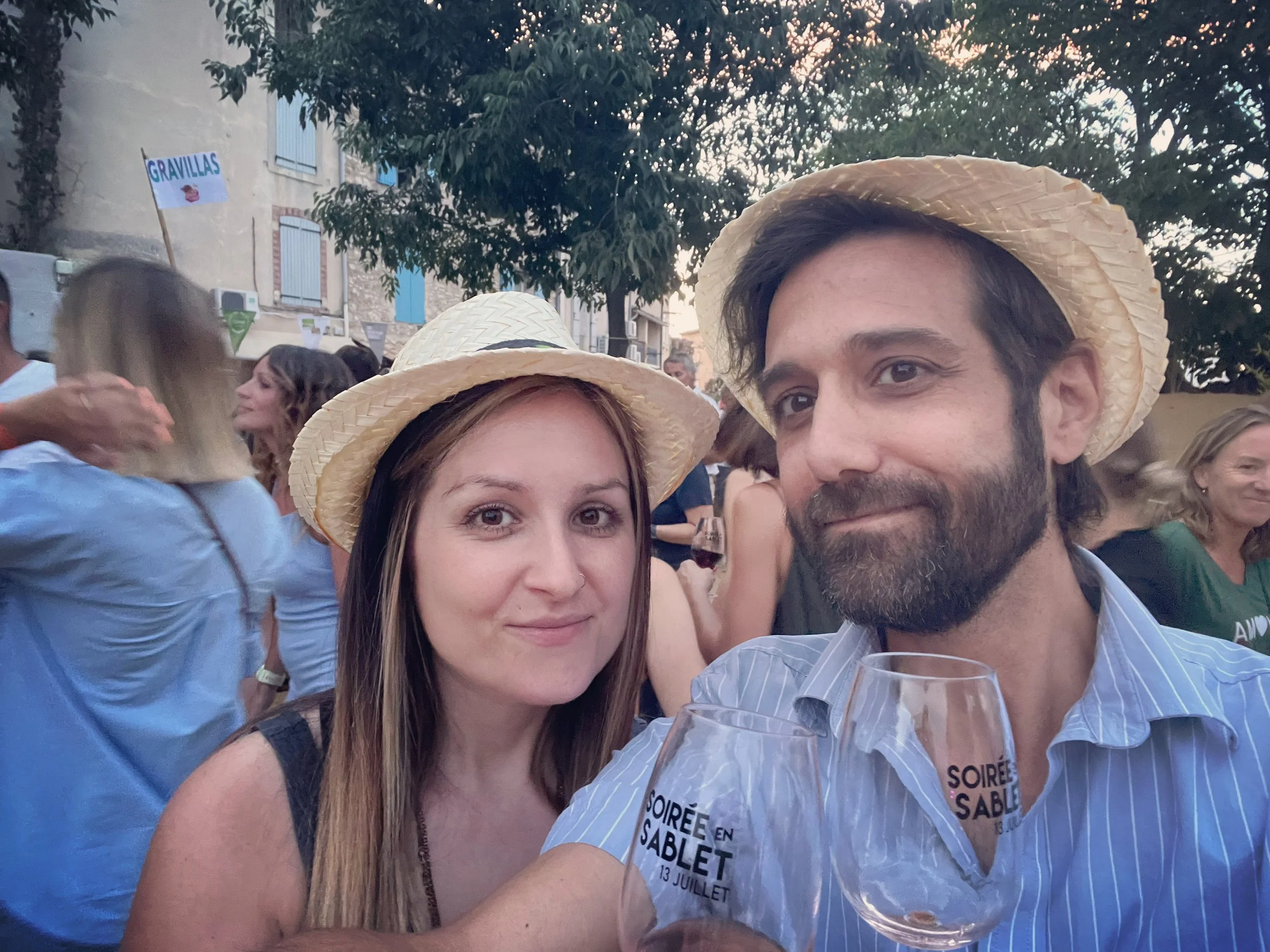
On the evening of the event, we parked at the bottom of the village and sat for a moment inside the car, watching people drift past in clusters.
“Should we go?” Andy asked, the question carrying more hesitation than curiosity.
I took a slow breath.
“I mean… why not?” I replied with a small shrug, though I wasn’t entirely convinced myself.
Once we stepped out of the car, we were absorbed into the steady current of visitors moving through Sablet’s narrow, windy alleyways. The air felt charged with summer anticipation and the slow release of Provençal heat as the sun began to slip behind the hills. Laughter ricocheted off the stone façades. Music pulsed faintly somewhere ahead. We let ourselves be carried forward, unsure of what awaited us at the end of the lane.
The crowd began to compress as we neared the center of the village, our steps slowing until we found ourselves inching forward in a loose, patient line.
“What are we all waiting for?” Andy asked.
“I’m not really sure,” I admitted, rising slightly onto my toes, trying to see over the shoulders in front of us.
It was our first wine fête and we really had no idea what to expect. In those early days, we stepped into everything blindly, collecting small missteps along the way. Time has a way of turning embarrassment into charm, and when I think back on those moments now, I feel a certain fondness for how little we knew, but how brave we were.
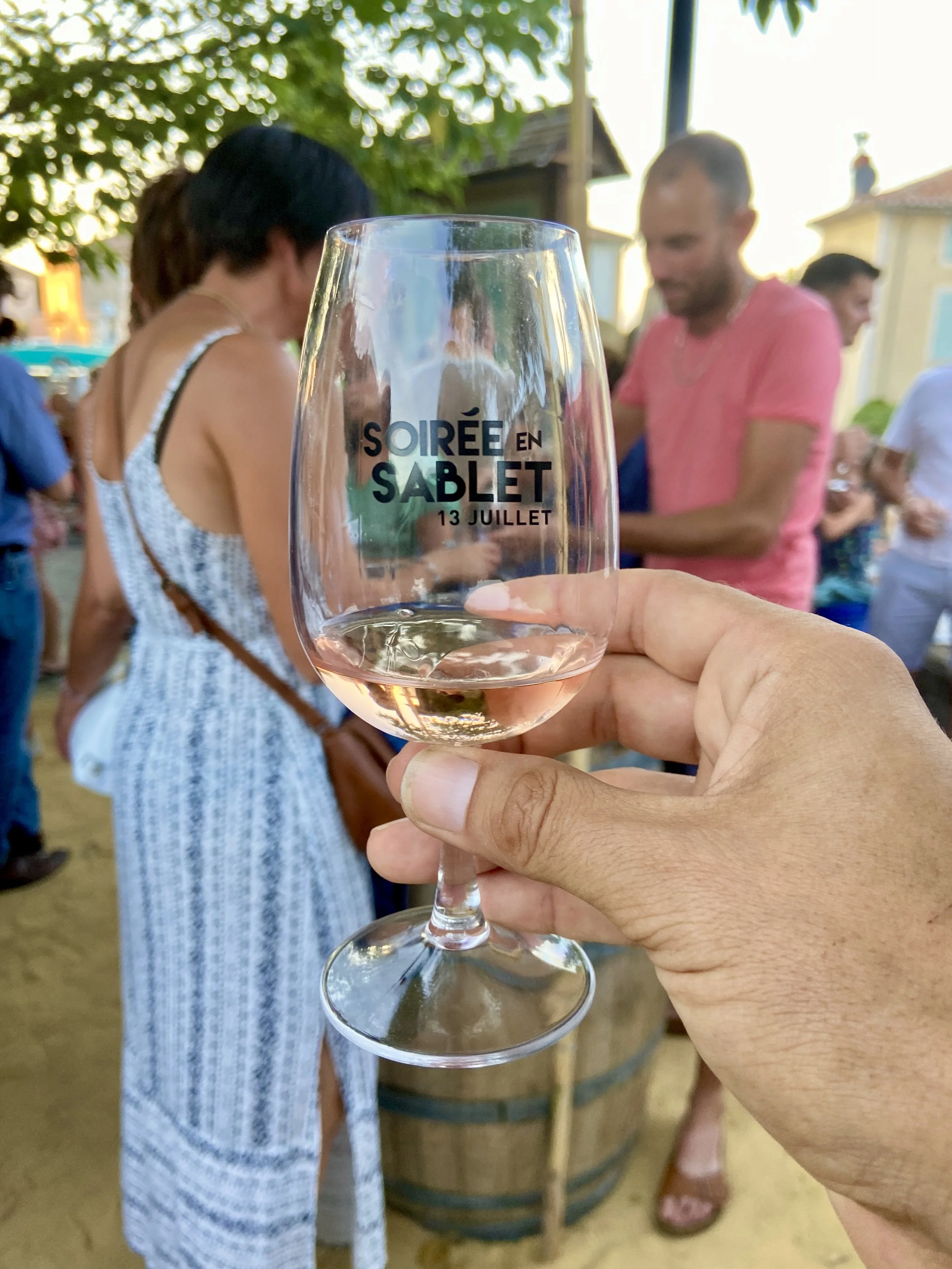
At last, the line shifted. It was our turn. We stepped up to a folding table just inside the entrance. Glasses clinked softly as they were lifted from neat stacks and passed into the waiting hands of customers. To one side, someone stood over a small cash box, taking folded euros and tucking them neatly inside before clasping it shut again. Glasses moved forward almost as quickly as the money disappeared, the rhythm quick and slightly uneven.
A woman caught my eye and motioned me closer to her side of the table.
“Bonsoir, vingt euros, s’il vous plaît,” the woman said, already reaching for two stemmed glasses.
“Twenty euros,” I translated softly to Andy, passing the bills across the table.
“Is it an entrance fee? What are the glasses for?” he whispered, trying to piece together the logic.
“Bonsoir,” I replied, pausing as I considered my next words. “I’m sorry,” I began in careful French, “this is our first fête. What do we do?”
Her face brightened.
“Ah, Américains!” she exclaimed, just loudly enough to undo any hope we had of remaining under-the-radar. I felt myself shrink slightly, wishing I could dissolve back into the crowd. Unbothered by my discomfort, she launched into a rapid stream of melodic French that washed over me faster than I could catch it.
I nodded along, catching fragments and missing the rest as nerves took over and the hum of the fête swelled in my ears.
When she finished, Andy looked at me expectantly.
“So?” his eyes asked.
“Ah… oui, merci!” I replied brightly, stepping aside with the glasses, hoping confidence might compensate for what I had not fully understood. Heat crept up my neck as we moved away from the table, two newcomers clutching our stems like proof that we belonged.
“What did she say?” Andy asked, quickening his pace to catch up with me.
I kept walking, hoping to put a bit of space between us and the entrance table before slipping back into English and attracting any more attention.
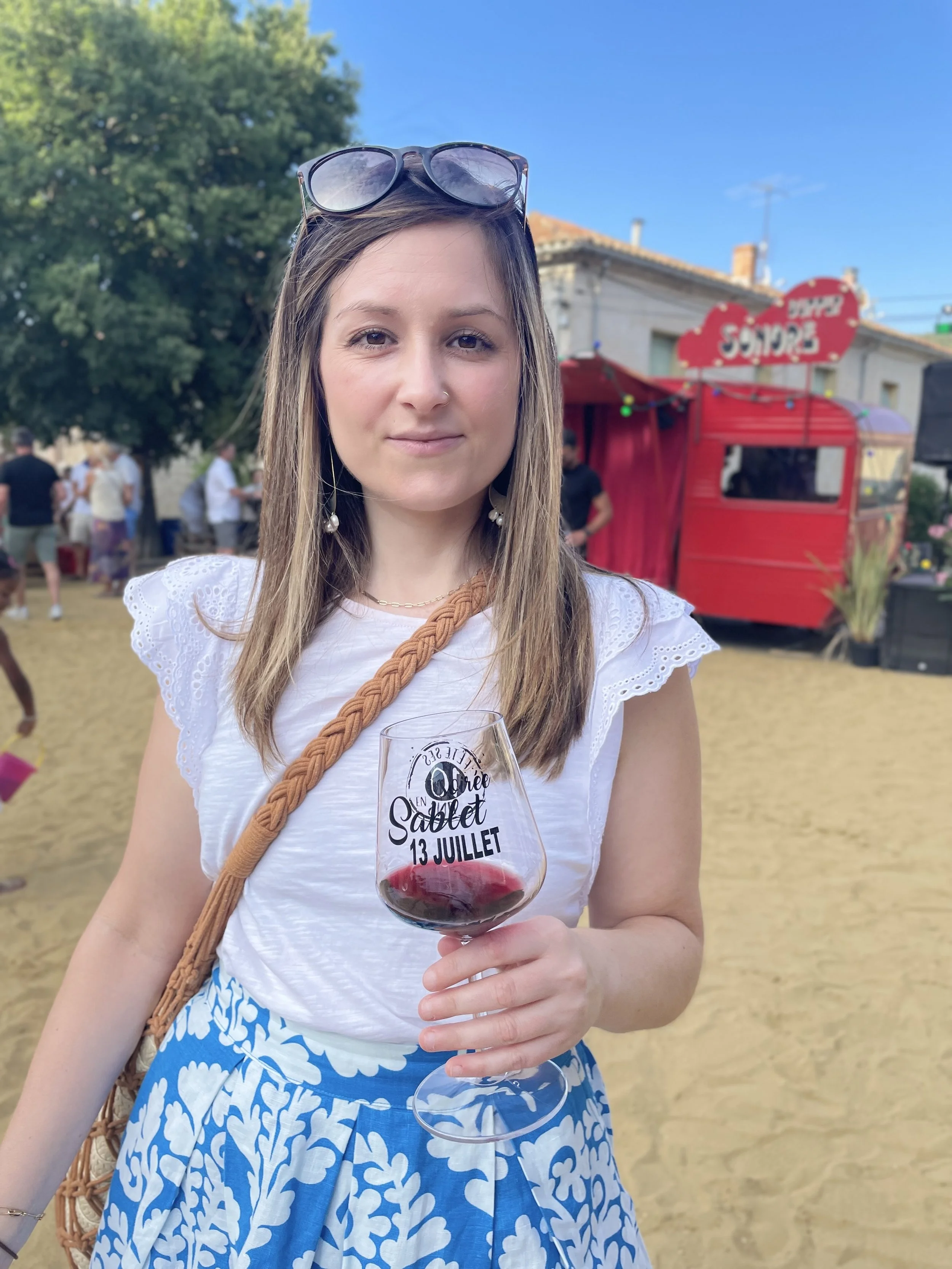
As we entered the town square, her words began to fall into place. The space had been transformed into something entirely unexpected. Sand blanketed the ground in a broad sweep of pale gold, shifting softly underfoot as people moved from barrel to barrel. Along the perimeter, different wineries stood behind makeshift tables, their flags marking each domaine for all to see.
“She said we take the glasses and make our way from domaine to domaine,” gesturing toward the wide stretch of sand where the wine barrels doubled as tasting tables.
“So the fee gets us a full Sablet wine tasting?” he asked, his excitement rising as he looked out over the square.
I glanced down at the ground beneath our feet, and suddenly everything began to connect.
“It’s a play on words,” I said, half laughing at myself. “I can’t believe I didn’t catch it sooner.”
I crouched slightly, letting my hand sift through the sand that blanketed the square, the grains slipping easily between my fingers.
“What do you mean?” Andy asked, his brow furrowing.
“Sable means sand,” I said, brushing my palms together as I stood. “Soirée en Sablet. A sandy evening in Sablet.”
He turned slowly, taking in the transformed square again, the barrels scattered across the golden sweep, the flags marking each domaine’s place in the crowd.
“Clever,” he said, a smile spreading across his face.
That night marked our first real step into the Provençal wine scene. We knew very little then. Appellations and cépages blurred together, and terms like structure and finish sounded more technical than meaningful. But we were curious, and at the time, curiosity felt like enough. We were blissfully inexperienced and completely invested, unaware of how deeply those sandy evenings would root themselves in the rhythm of each of our summers.
A few days after the Soirée en Sablet held this past summer, I slid into the passenger seat of the scalding car, heat rising in waves from the dashboard. I reached toward the center console to make room for the house keys and our pocket WiFi, already bracing myself for what I might find.
Andy has a habit of treating that small compartment as his personal catchall. Since he drives the car far more often than I do on his trips to the dialysis clinic, receipts, folded papers, and forgotten odds and ends tend to accumulate there, waiting patiently for the next time I climb into the car and quietly restore order to the small space.
As he began entering the address of our destination into the GPS, I continued sifted through the clutter I had pulled out, stacking papers into a neat pile and then, something caught my eye.
“Hey,” I said, holding up an elegant, black business card I had just fished from the pile.
He glanced up from the GPS, then back at me.
“Why do you have this?” I asked, more sharply than I intended.
He blinked, startled by the sudden intensity over what was, after all, just a piece of paper.
“Should I not have it?” he replied, his own defensiveness rising to meet mine.
“No, no. Of course you can have it. It’s just… where did you get it?” I softened, trying to retrace the card’s path into our car.
He shrugged and took it from me, turning it over in his hands as if the answer might be printed somewhere on the back.
“I don’t know,” he said slowly. “I grabbed it at the fête in Sablet. I remember really liking their wine.”
“You’ve never taken a domaine’s card before. I think I’m just surprised,” I said, pulling it gently back into my hand for further inspection.
“I feel like this is a sign,” I added, giving the card a small wave in front of him.
“Why would this be a sign?” he asked, half amused.
“Because even though I was given specific recommendations for Sablet winemakers, I still wrote down their name after driving past their domaine and the moment I saw their website, something clicked,” I said, snapping my fingers for emphasis. “I knew it was them. I knew they were who I wanted for my series.”
I handed the card back to him, the weight of it suddenly feeling less accidental.
“What exactly was on their website,” he asked, narrowing his eyes.
He was right to ask. By that point, I had seen more domaine websites than I care to admit, and many of them had begun to blur together. Domaine La Perdrière included all the elements one would expect from a site promoting their wine, but what caught me immediately was the carousel of photographs shifting from sweeping, scroll-stopping landscapes to playful, unguarded moments of the owners, Vasco and Sonia. The photos just exuded personality and charm. I instantly wanted to meet them.
“I know this is going to sound silly, but they seem so, so hip!”
“Hip?” Andy repeated, raising an eyebrow.
It wasn’t a word I used all that often, which only seemed to make him more curious.
“I know, wine and hip usually aren’t two words that are usually found in the same sentence, but just look at them. They seem like such a fun couple. And, let’s be honest, adding these type of photos to your website is a choice. It’s fun. Not many people portray wine as fun.”
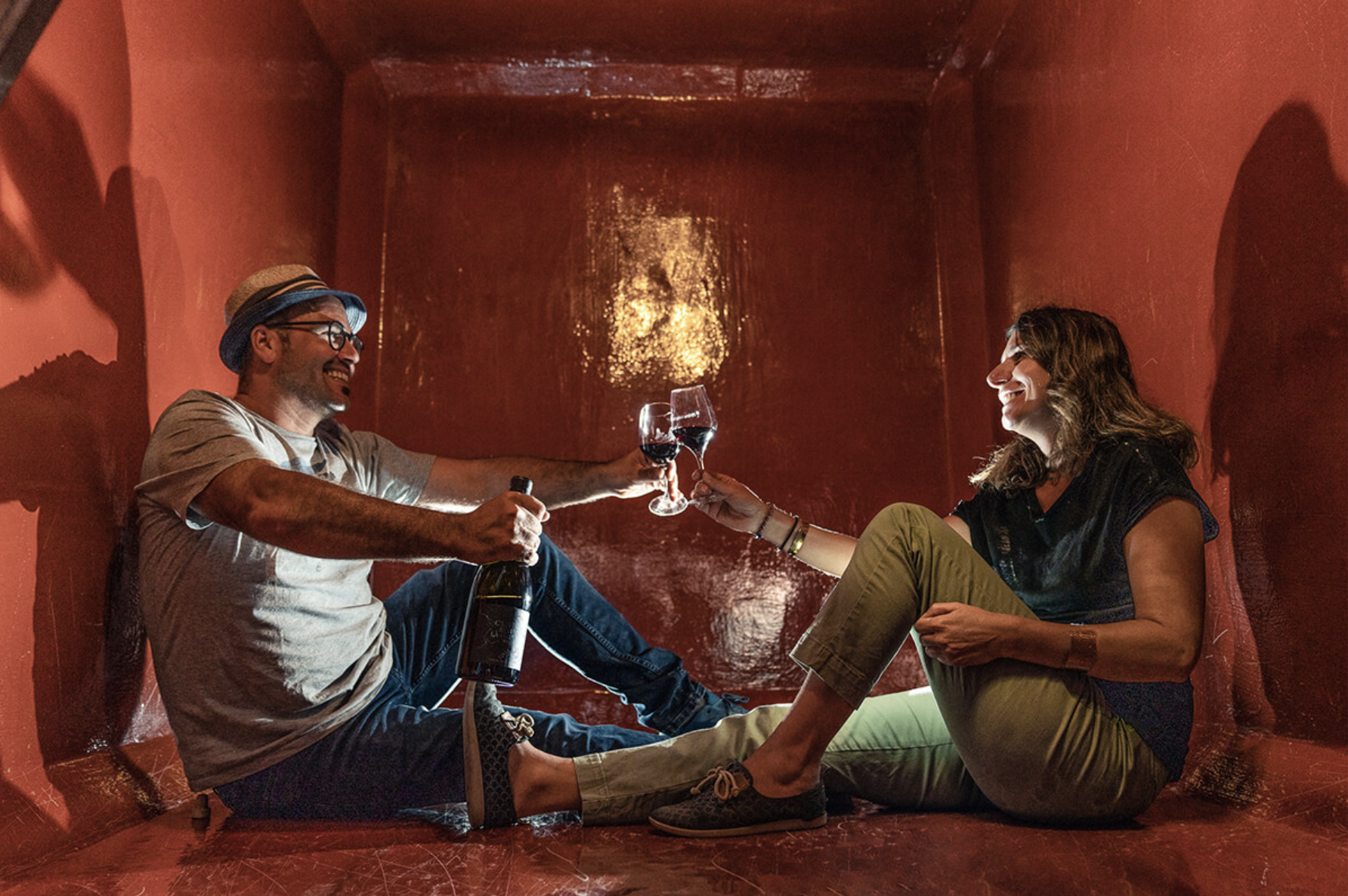
I turned my phone toward him as the photos on the domaine’s website slowly filtered past. For a moment it felt less like browsing a winery’s page and more like flipping through the feed of two friends documenting their adventures in winemaking. In one image, the couple lay flat inside an empty wine vat, grinning up at the camera as they popped their heads through the round metal hatch. In another, they sat inside a fermentation tank with their legs stretched out between them, raising their glasses in a quiet toast while the cellar light reflected softly off the curved red walls around them.
Something about the images felt different from the other domaines I had been researching. Most winery websites show tidy rows of vines, bottles carefully arranged on wooden tables, and portraits of winemakers standing solemnly among their barrels. These photos, though, told a different story. They hinted at a partnership, a sense of humor, and a kind of ease with the work that only seems to come when people genuinely love what they do.
I kept scrolling, lingering longer on each photo than I had with the dozens of other domaines I had looked through that afternoon.
The images felt almost cinematic… curated, thoughtful, and entirely different from any of the other winemaking families I had chosen. Somewhere between the harvest scenes and the quiet corners of the cellar, the couple began to take shape in my mind.
There was a lightness to it all. Not in the work itself, but in the way they carried it. Serious when it needed to be, but never more than that. The kind of presence that makes everything feel a little more human.
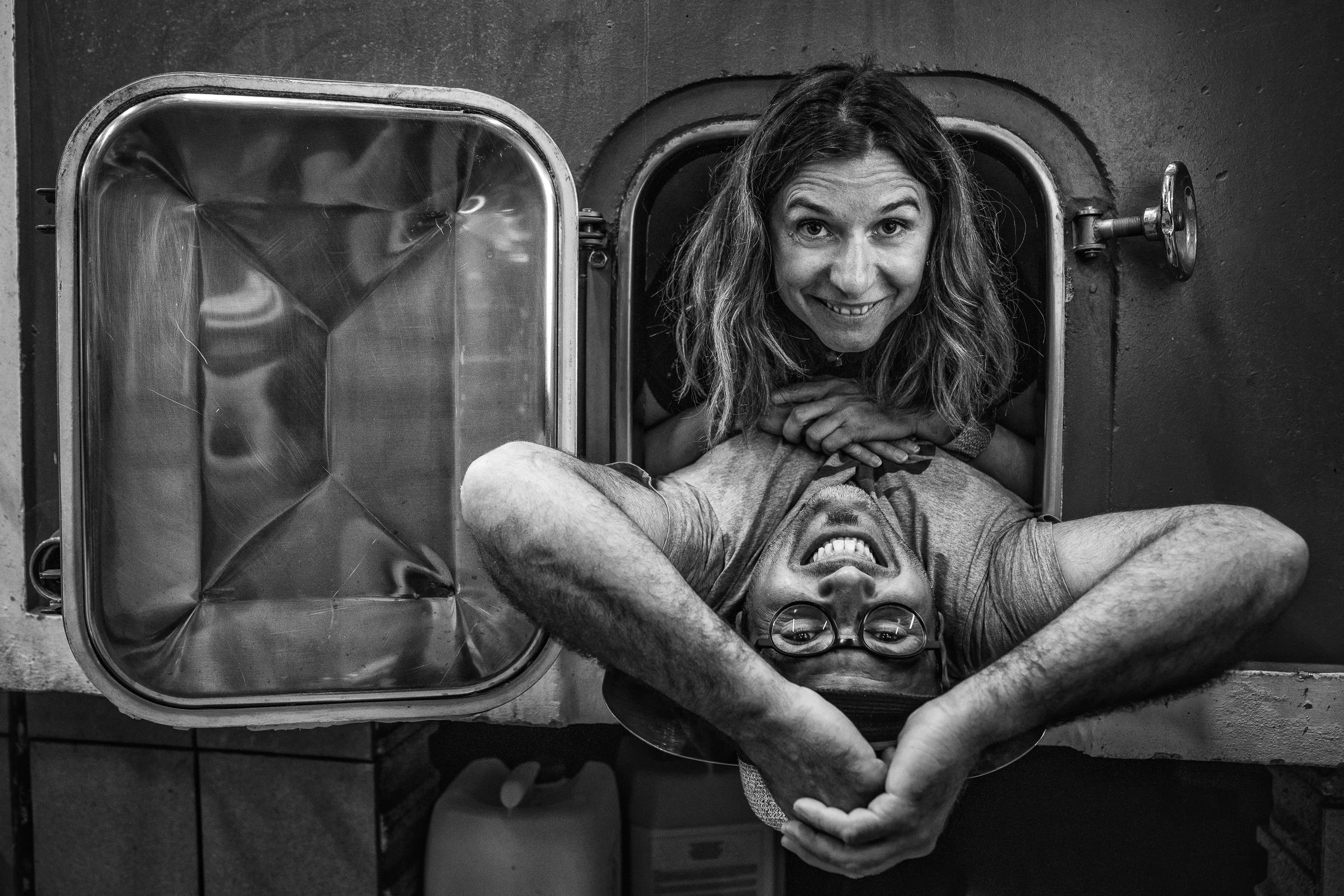
The only problem? After reaching out, hoping to arrange a visit and learn more about the people behind Domaine La Perdrière, and the personalities behind the photos, I hadn’t heard anything in return.
Still, I knew how the rhythm of the season worked. Summer in Provence moves quickly. Village wine fêtes fill the squares, night markets stretch late into warm evenings, and the calendar across the region begins to crowd with festivals and gatherings.
For the domaines, it is one of the busiest times of the year, apart from the harvest.
“Have you tried reaching out again? Sometimes things get lost in the shuffle,” Andy reasoned.
In reality, only six days had passed since I had sent my first email. In American time that can feel like an eternity. In French time, hardly any time had passed at all.
When I followed up later that afternoon, I mentioned how taken Andy had been with their wine and how I had even found one of their business cards tucked into the console of our car from the Soirée in Sablet.
It felt like a small but reassuring detail, proof that this message had not been sent from behind a desk chair thousands of miles away, but from someone who had spent very real afternoons wandering the villages in and around their vines and fields.
I clicked send, trying not to think about it too much and continued on with the rest of my afternoon.
Within a few hours, an email was waiting for me explaining that my first message had indeed been received, but that she and Vasco had simply been very busy with a brimming schedule of summer commitments. She also suggested a time for me to come visit and learn more about the domaine and their story.
I closed my computer and wandered into the living room, sinking into the couch beside Andy as he typed away at a project due when his clients began waking up an ocean away.
“I got a response,” I started.
“And?” He prodded, not needing any further context about who.
“We are going to visit on Thursday,” I confirmed with a nod. “They had just been busy and forgot to respond.”
“See, it had nothing to do with you personally. Your reminder was probably helpful to put your email back on their radar,” he smiled.
“Yeah, but I’m nervous,” I admitted, scrunching my face.
“Nervous? Why? You’ve done four of these so far. You’re a pro,” he said, snapping his laptop closed and shifting his body to face me.
“No, no. I’m not nervous for the actual visit. It’s more the meeting. Like I said, they seem so hip. I’m just a dorky girl from a Rust Belt town,” I added, layering on my self-doubt.
“But that is your charm!” He said swinging his arm around me in an attempt to comfort me.
His reassurance made me laugh, even if the nerves were still there. The truth was that meeting the people behind the wines I had come to admire always carried a certain weight. These visits were never just about tasting wine. They were about stepping into someone else’s story, if only for an afternoon.
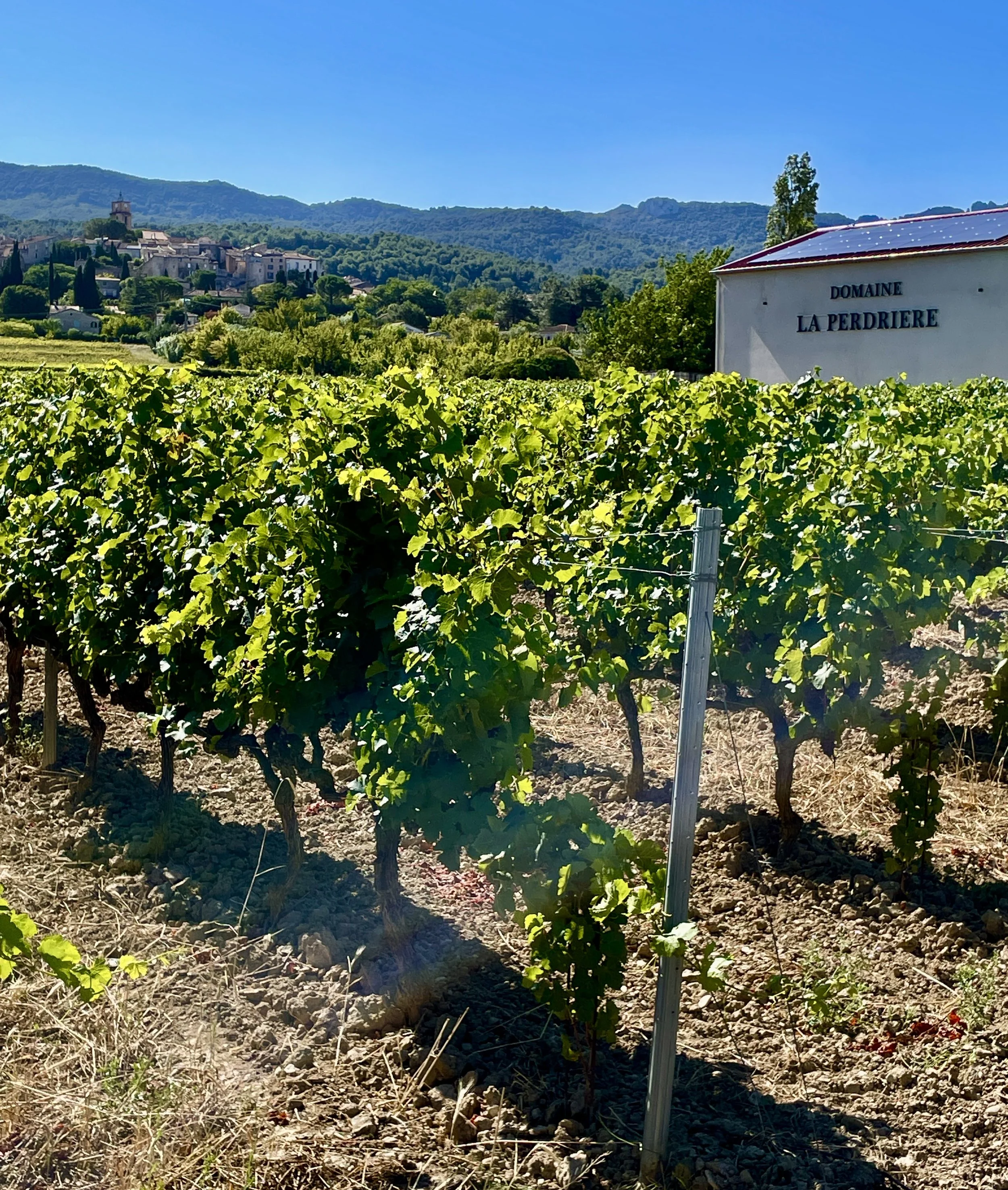
That Thursday, as we pulled into the domaine, neither of us reached for the door handle right away. The car sat idling in the gravel lot while we took it all in.
Vines stretched out in every direction, their orderly rows rolling gently across the landscape. Beyond them, the sweet little village of Sablet rose quietly in the distance, its bell tower poking up among slow-moving white clouds. Set even futher back, the jagged peaks of the Dentelles de Montmirail cut sharply against the sky, their pale limestone catching the afternoon light.
“Not a bad office,” Andy said finally, breaking the silence. I nodded, finally reaching for the door handle.
As we entreated inside the tasting room, Sonja looked up from a desk tucked at the back of the space. A stack of papers sat beside her keyboard, and the glow of her computer screen softly lit the wall behind her. As soon as she spotted us, she pushed her chair back and made her way around the counter with an easy smile.
In her email, Sonja had warned me that her English was only “a little,” adding that Vasco would be better able to explain the story of the domaine, as he was the English speaker of the two.
That late morning, however, when we arrived, he was still out among the vines, finishing a few things before the afternoon sun grew too intense to work.
While we waited, Sonja laughed and waved off the language barrier with an easy shrug. Between fragments of French and the occasional English word, we began piecing together the story of how the couple had found their way to this little corner of Provence.
“I used to be a nurse before all of this,” she said, extending her hand toward the bottles that lined the walls. “So when you mentioned scheduling your visit around dialysis, I understood.” She nodded gently in Andy’s direction.
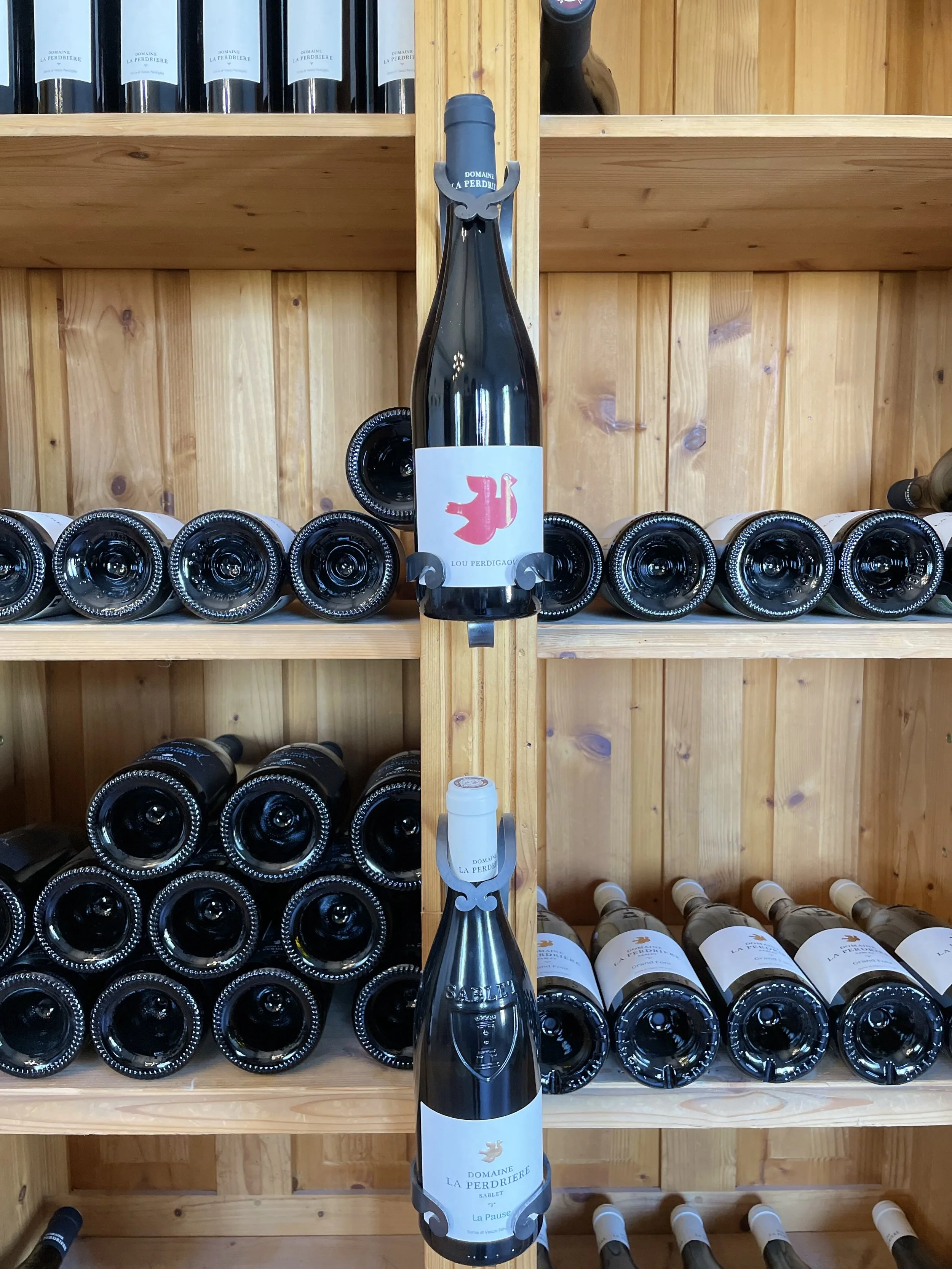
As the two of them slipped easily into a conversation about France’s healthcare system, I wandered toward the shelves that lined the tasting room. Bottle after bottle stood neatly arranged, but something caught my eye.
The names did not all match.
I leaned closer, tracing the edge of a label that looked older than the others, its paper slightly weathered at the corners. Some bottles carried the same clean design, while others bore an entirely different name.
I was still piecing it together when the door swung open behind me.
The sound carried across the room. Conversation paused and everyone turned toward the entrance.
Vasco stepped inside, brushing a bit of vineyard dust from his hands. His sun-tanned skin spoke of long mornings spent among the vines, and his smile arrived before he did.
“Bonjour.”
“Bonjour,” we echoed back.
A few pleasantries were exchanged in typical French fashion before Sonja began filling Vasco in on the conversation he had missed while he was in the vineyard.
But my attention had already drifted back to the bottles. As their conversation began to taper off, I took the cue to ask the question that had been sitting in the back of my mind.
“Why do these have different names?” I asked, lifting one from the shelf and turning the label toward the group. It felt worn beneath my fingers, like something from another chapter of the domaine’s story.
Vasco glanced at the bottle and smiled knowingly.
When they first arrived in 2010, he explained, the domaine had already existed under another name. The previous owner was retiring, and with no one in the family interested in taking over, the property had quietly passed into their hands.
Wine, he told us, had been part of his life long before Provence entered the picture.
As he talked about his background, I mentioned that his name had stood out to me. It did not sound very French.
He smiled.
“My father is Portuguese,” he explained. It was his father who first introduced him to the world of wine. What began as a simple curiosity gradually grew into something much, much deeper.
During the dictatorship, his father fled Portugal and eventually met Vasco’s mother, who was French. After the fall of Salazar, the couple returned to Portugal, and it was there that Vasco was born.
“But we didn’t stay long,” he added with a small shrug.
When he was two, the family moved back to France and settled in Paris, where he grew up.
After studying viticulture and winemaking, Vasco spent the next ten years working in the northern Rhône Valley, honing his craft among the steep, storied vineyards of Saint-Joseph, Condrieu, and Côte-Rôtie.
“That’s where we met,” Sonja added with a smile. It was her home region, and at the time she was working there as a nurse, something she had referred to earlier with a laugh as her life “before all of this.”
When the opportunity to take over the domaine in the Vaucluse appeared, the two decided to take the leap together, with Sonja stepping away from nursing.
The early years of owning the domaine moved quickly. Between the vineyards, the cellar, and raising two small children in a completely new region of the country, their days filled easily.
Their daughter was barely two when they first arrived, and their son was born not long after. The vines and cellar demanded constant attention, so the name that came with the property remained for the time being. The idea of leaving their own mark on the domaine would wait until life felt a little more settled.
Over time, the estate began to grow. In 2014, they added six hectares in the Séguret appellation, expanding both their land and the wines they produced. Yet the moment to change the name never quite seemed to arrive.
Until 2024.
That year, they began renovating the cellar. If the space itself was going to change, Vasco explained, it finally felt like the right moment for the domaine’s name to change as well.
“We did everything at once,” he said with a laugh.
With a quiet excitement, the two of them gestured toward the back of the tasting room.
“Come,” Sonja said, urging us to follow, eager to share their new space.
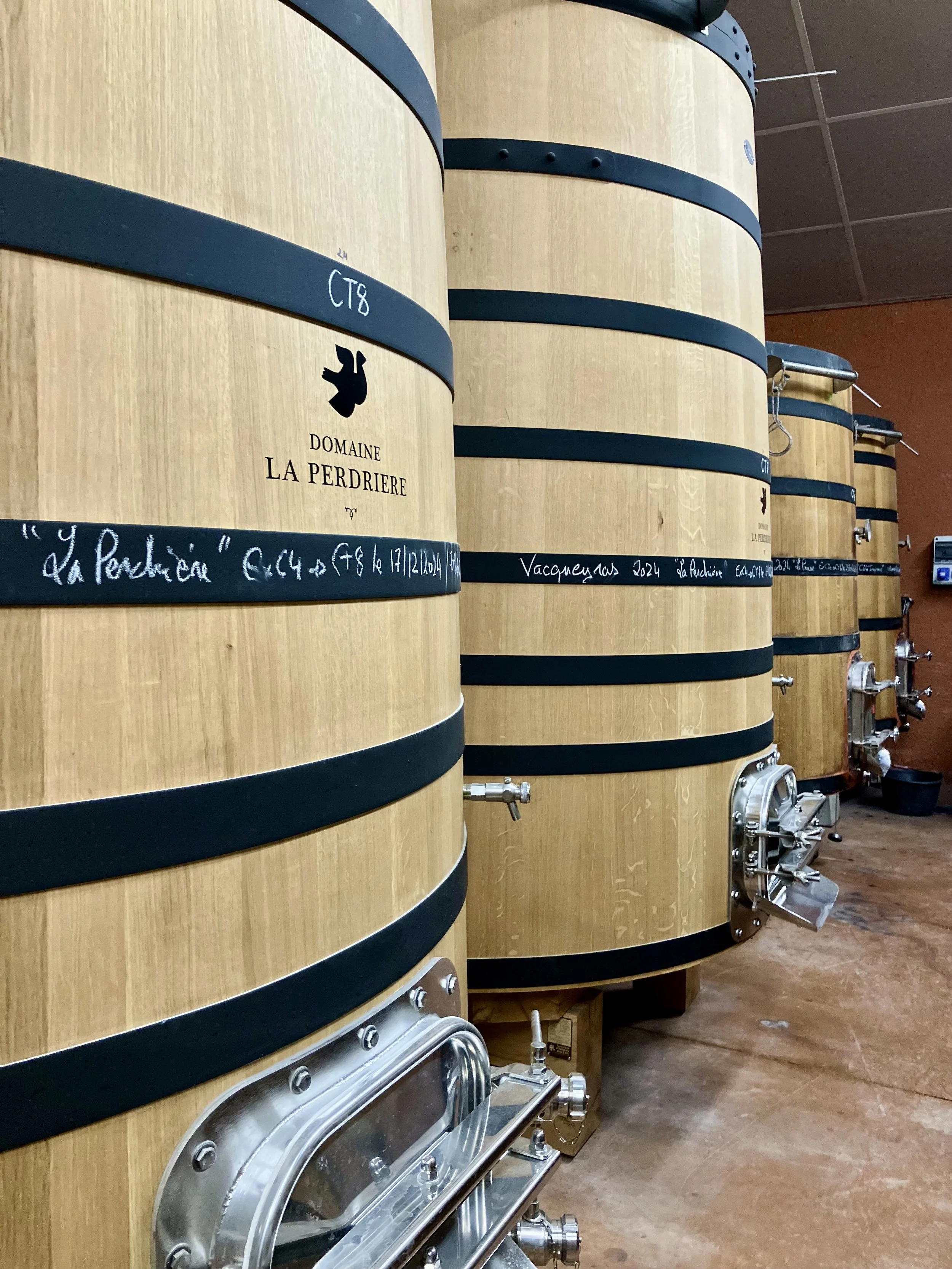
They led us through the door at the back of the room, and the space opened suddenly into a bright cellar. Sleek, oversized barrels stood upright in tidy rows along the perimeter, but my eye was drawn immediately to the center, where large clay amphorae rested on sturdy bases, their rounded forms topped with delicate glass airlocks quietly bubbling. It was the first time I had seen this style of vessel used in a working cellar, and it caught my attention.
Peering between the sand-colored vats, I noticed a pyramid of familiar wooden barrels stacked neatly behind them, like old guardians watching over the new arrivals.
Sonja paused as a tradesman approached, asking for clarification on one of the final details of the renovation. She excused herself and followed the him out of the room while Vasco led us into another space. This one was lined with towering red cement vats, their painted surfaces marked with chalk from recent harvests. These were the same vats I had seen the two of them sitting in on their website. I smiled, thinking back to the photo that had first caught my attention. The air was tinged with the scent of cool stone and gently fermenting fruit.
I glanced back over my shoulder into the previous room, still captivated by the different styles of fermentation Vasco and Sonja were using for their grapes.
Rather than replacing one another, each vessel seemed to hold its place in the cellar. Old barrels, modern tanks, amphorae, and cement vats existed side by side, creating a quiet balance between tradition and experimentation.
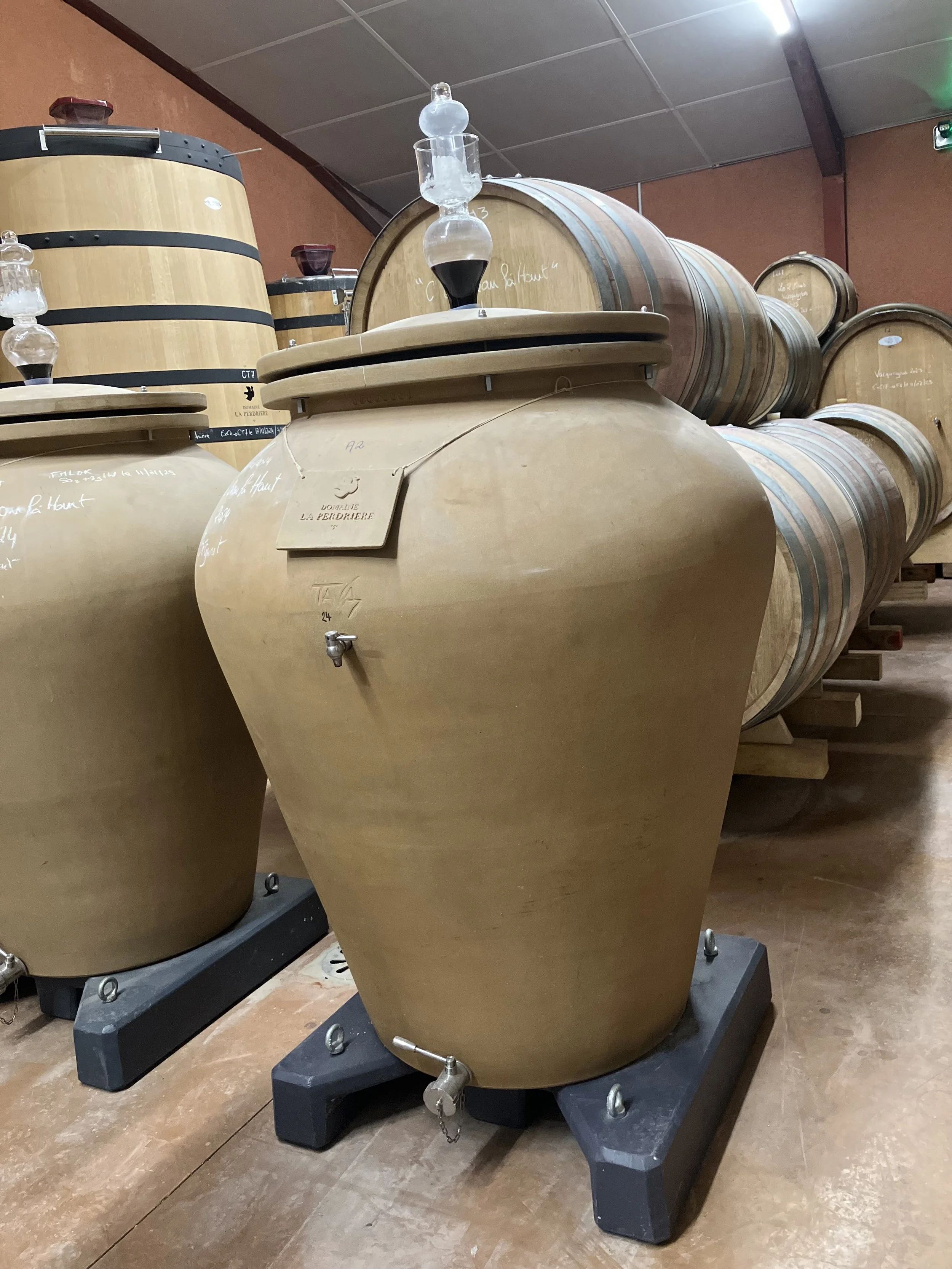
Vasco continued leading us deeper into the newly constructed space, insisting there was something he could not wait for us to see. He slowly guided us up a flight of newly finished stairs, still partially open and revealing the dimly lit bottling area below.
Some of this section was still waiting to be officially deemed finished before finding its official purpose, but Vasco led us confidently into a room he already had big plans for. His smile widened as he stepped inside.
“I was thinking of holding tastings up here,” he said, walking over to the long row of windows and gesturing for us to come closer.
Beyond the long stretch of glass, his vines spread out below us, with the village of Sablet rising gently in the distance.
“This is quite the view!” Andy exclaimed, pausing to take it all in, the landscape beyond, and the work that had brought them here over the past fifteen years. With the final details of the new building being finished and the new name continuing to take root, it felt like the beginning of a more personal chapter for the domaine.
As we made our way back down the stairs, Sonja was wrapping up a few final details with the tradesman. Once everything settled, the worker sauntered off and we all headed back into the tasting room.
“What would you like to try first?” Vasco asked, grabbing a wine key and walking over to the shelf lined with bottles in various states of being enjoyed.
Sonja gathered a few glasses from behind her desk and began to follow him.
“Oh, none for me,” Andy added sheepishly, holding up his hand to stop her before she got too far. “I have to monitor my liquids.”
Sonja already understood. Having worked as a nurse, she knew the restrictions dialysis patients live with. She nodded knowingly and slid one of the glasses back onto the counter, passing the other to Vasco.
“Well, I like red, and I don’t mind something dry,” I explained, hoping I sounded more knowledgeable than I felt.
His hand immediately reached for a dark bottle labeled C’est Beau, Là-Haut, or “It’s beautiful up there.”
This particular wine, he explained, is made from his oldest vines in Séguret and spends one of the longest periods aging in the cellar. I was intrigued.
As he poured the liquid into the large, curved glass, the smell immediately hit my nose. Strong and intense, I knew I was going to like it.
As I took a timid sip of the glass passed to me, Sonja and Vasco waited, gaging my reaction.
I paused, letting the wine settle in my mouth and reveal itself. It was bold and deeply structured, yet balanced by a striking minerality that reflected the limestone and quartz soils Vasco had just described. It felt powerful, confident, and unmistakably tied to the land around Séguret.
This would be a hard wine to follow.
“This… I like,” I said casually, trying not to sound like an overly enthusiastic American drinking wine for the first time.
The couple smiled. As Vasco pulled more bottles from the shelf for me to try, Andy wandered the room, taking photos of the space, hoping to encapsulate the couple, the wine and their journey.
As the tasting began to wind down, my attention returned to the first wine I had sampled, C’est Beau, Là-Haut. My mind drifted to snowy, frigid Pittsburgh in the middle of winter. I could see it clearly, sitting on the couch, a blanket pulled close, a glass in hand, and a book open somewhere between pages.
“I will take one of these,” I said, pointing to the bottle as my eyes searched the room for its place in the wall display.
Andy’s eyes followed mine, scanning the few he had been photographing. Finding it, he pulled one from the rack and held it out.
“Would it be alright if I grab a photo of this with the vines out front?” he asked, nodding toward the door.
They smiled and agreed, already beginning to tidy up the tasting space as our visit came to a close. Glasses were gathered and bottles recorked, the quiet rhythm of the room returning as if it had all just been a small pause in their day.
We said our goodbyes, lingering for a moment longer than expected before stepping outside and back into the warm Provence afternoon.
Tucking the bottle under my arm, I followed Andy out into the vines that bordered the domaine. The light was bright and steady and a warm breeze softly rustled through the leaves of the tightly packed vines. He stepped back to frame his shot while I held the bottle for a moment, turning it slightly in my hands before passing it back to him.
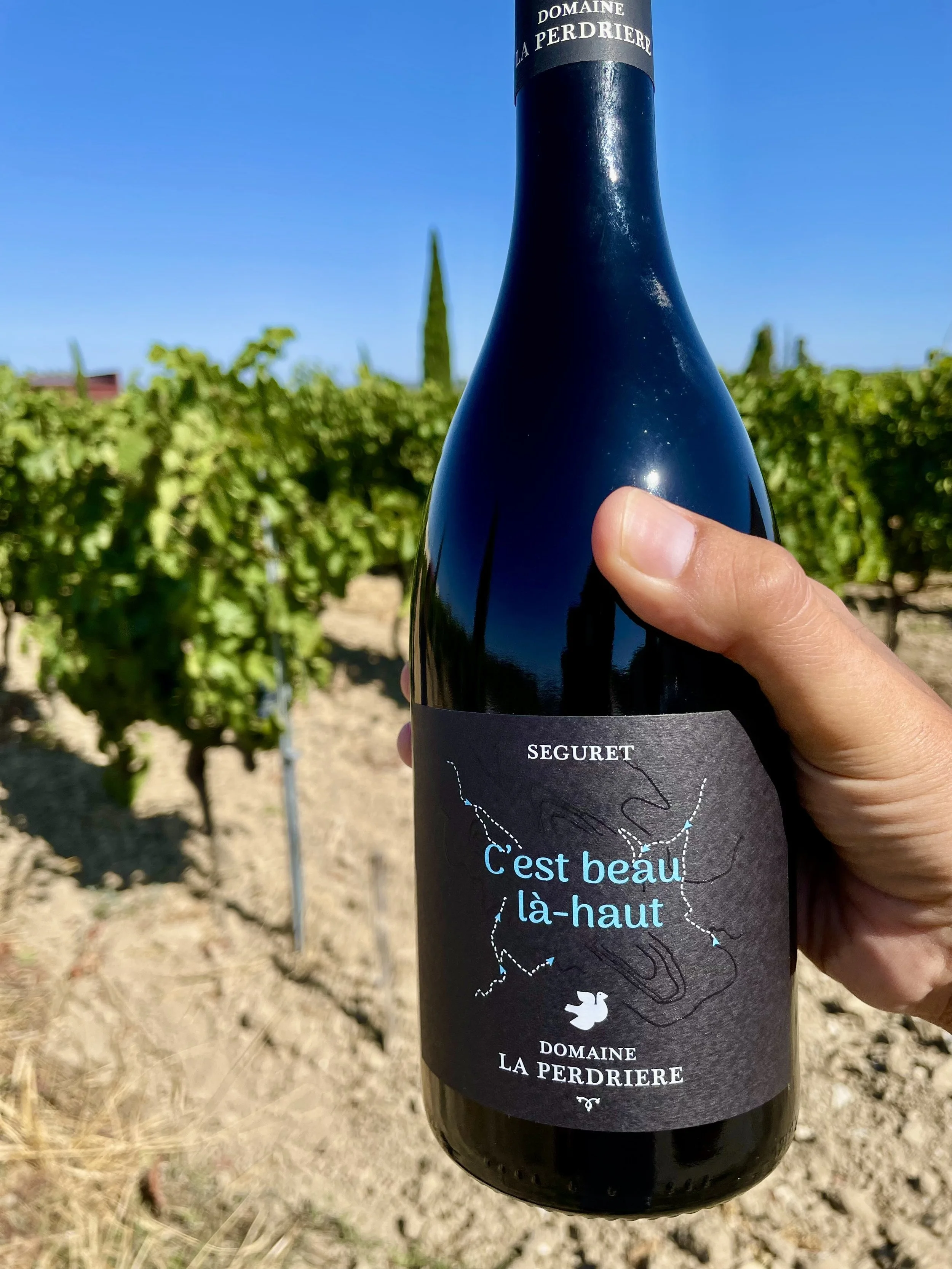
The moment felt like something I would return to later.
Months from now, back home in Pittsburgh, I will open this bottle and find myself here again, standing in the vines, the light just as steady, the moment just as clear, carrying with it the quiet imprint of the domaine and the hip, unassuming couple at its center, along with the evolution quietly unfolding behind its new façade.
Visit Domaine La Perdrière
Visiting Provence and hoping to enjoy a wine tasting?
Vasco and Sonja would be delighted to welcome you.
9 A.M. to 12 P.M. and 1 P.M. to 5 P.M.
Monday to Friday
The weekends by Appointment
Address: SCEA Famille Perdigao
280 Route du Parandou 84110 Sablet
E-mail: Contact@domainelaperdriere.fr
Phone: +33 (0) 4 90 46 94 75