A Visit to le Mas des Flauzièrs
A visit marked by conversation that felt refreshingly untouched by algorithms.
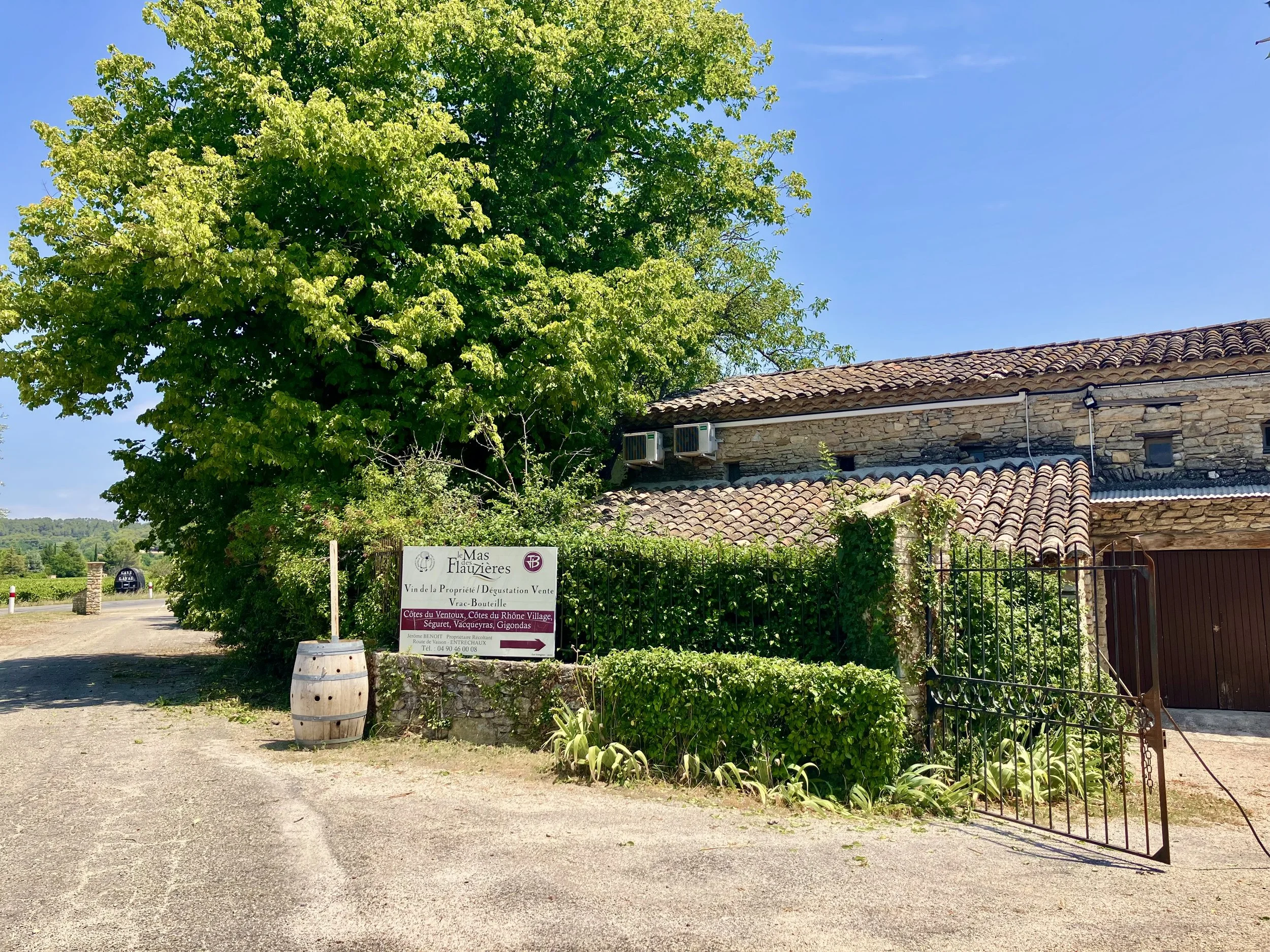
It was our second-to-last day in Provence when we found ourselves driving along an unfamiliar country road on the outskirts of Vaison. We had just finished breakfast at our favorite bakery in Faucon, a ritual we repeat each time we are about to leave Provence, when the GPS led us home using an alternate route. Rather than being bothered by the change in navigation, we blissfully followed along, welcoming the subtle shift in scenery and savoring those final hours in our favorite part of the world.
We were still about ten minutes outside of Vaison when the car rounded a wide bend lined with lush vines. The road curved, then straightened, and suddenly, as if out of nowhere, the crumbling ruins of a château appeared, perched high above the tiny village and cascading down the rocky hillside. My breath caught.
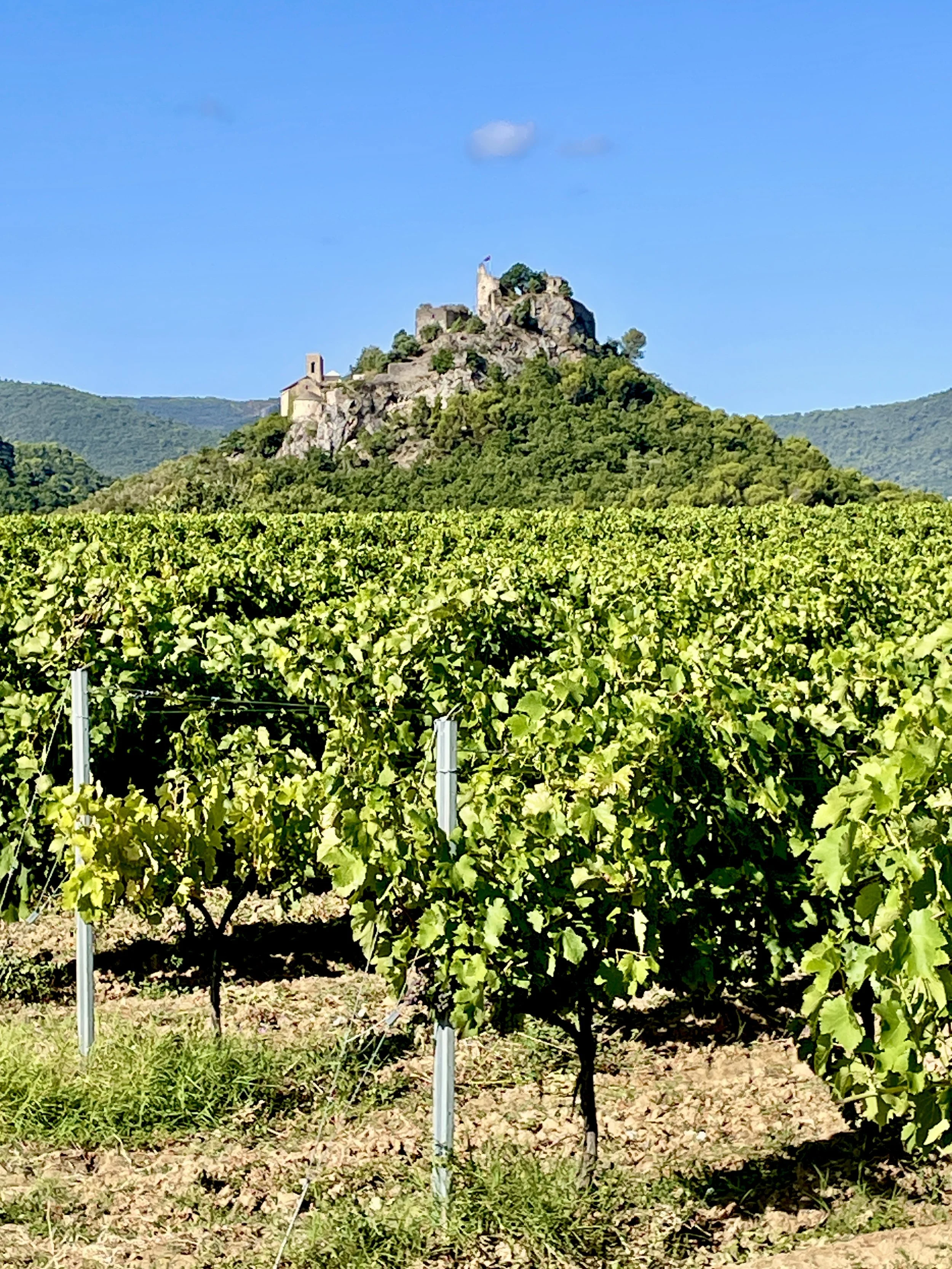
“Pull over, pull over,” I said, hoping I’d given Andy enough time to navigate the road and find a place to stop before we were swept into the narrow lanes leading to the heart of the village. I leaned farther out the window as the grand structure loomed closer and closer. The car slowed, came to a stop, and Andy turned off the engine.
“Where are we?” I asked, fumbling for my phone to check our location. The village was so small it didn’t even register on the car’s GPS.
Entrechaux.
Meaning “between two castles” in the Provençal language, Entrechaux historically sat between two defensive points. The medieval castle ruins towering above the village before us formed one line of defense, while another fortified site nearby once controlled the valley and its access routes.
I took a step back, letting myself take in the sheer beauty of the scene around me. People travel this road every day with this as their view. Those who live in the village below go about their daily lives, likely without giving a second thought to the fairytale structure teetering high above their rooftops.
I hope I never take views like this for granted —though, of course, it’s easy to think that way when it isn’t your everyday reality.
Sliding back into the passenger seat, I shifted the thin brown bags, each blotched with butter from leftover pastries, that I’d left along the center console as I searched for my phone. Once I found it, I opened my notes app and scrolled through my ever-growing “Provence” list, buried among dozens of other entries.
Each summer, I keep a notes tab at the ready on my phone, jotting down any place or experience I stumble upon and don’t want to forget. I open it and quickly type in Entrechaux, knowing it will sadly remain unchecked until the next time we find our way back to Provence.
The next summer, as my series on small, family-run domaines began to grow and take shape, I found myself thinking back to that tiny town with its looming château. Something about it captivated me. Maybe it’s because I am a Pisces and often considered a dreamer with my head in the clouds, but I found myself reminiscing about the village often. Entrechaux felt magical and I knew that it had to be included as one of the neighboring villages so often skipped in favor of the region’s more famous tasting rooms.
“I have to find a domain in Entrechaux,” I told Andy, pulling up my ever-growing notes tab for Provence.
“Where?” he said, narrowing his eyes as he glanced over at me from the driver’s side of the car.
Exactly, I thought. Entrechaux is barely a ten-minute drive from our house, yet the fact that he had to ask where it was made it exactly the kind of place I wanted for an off-the-beaten-path series.
Throughout the summer, as we drove through the Vaucluse region of Provence, I kept my phone in hand, notes app open and ready to capture any detail worth remembering. Every few miles, a hand-painted sign or roadside billboard would appear, beckoning visitors to turn off for a dégustation, a wine tasting. This was my cue.
I would quickly type the name of the domaine into my notes and, later in the day, over a bowl of olives and a glass of rosé, visit its website to see whether it matched the spirit of my article series. Some car rides yielded fifty or more domaine names, but I knew what I was searching for and easily weeded out those that felt too corporate or disconnected from the process. I was in search of authenticity.
After a bit of exploration and research, I had four domaines on my list in and around the village of Entrechaux. Each had something distinctive that set it apart, but it was a single phrase on Le Mas des Flauzièrs’ website that made it immediately clear this was the domaine I had been searching for.
Owner Jérôme Benoit described himself as a propriétaire-récoltant, or a winegrower who owns the vineyards, harvests his own grapes, and produces and sells the wine, typically under his own name. Everything is done in-house, from vine to bottle, which is exactly what this article set out to celebrate. This was my domaine.
To me, calling oneself a propriétaire-récoltant speaks to a level of authenticity, a direct connection between the land, the grower, and the wine, and often signals a family-run, small-scale operation rooted in tradition and care.
When I reached out, Jérôme responded with genuine enthusiasm, both at the prospect of being featured in such a niche article and at the opportunity to share his family’s legacy. We set a time for Andy and me to visit the domaine the following week, officially beginning my deeper dive into the families who quietly form the backbone of the region’s terroir.
As our visit approached, that familiar mix of anticipation and nerves crept in. Instead of heading straight to the tasting, Andy and I decided to return to where it had all begun and finally explore the little village that had stopped us in our tracks months earlier. Wandering through Entrechaux and eventually climbing toward the château felt like the right way to experience the place before officially stepping into the cellars of Le Mas des Flauzièrs.
We pulled into Entrechaux in the heat of the early afternoon, parking beneath the shade of a row of towering plane trees near the ancient church anchored at the base of the château and at the center of village life. From where we stood, the ruins barely revealed themselves, fragments of stone breaking through the dense canopy of trees high above.
“So how do you think we’re supposed to get up there?” Andy asked, lifting a hand to shield his eyes from the bright, Provençal sun.
I scanned the village, then pointed toward a single narrow road that hugged the hillside. “If I had to guess,” I said, “that’s our only option.”
We crossed the road and began our climb, passing village homes carefully built into the hillside and lining the path toward the once-grand château. As we ascended higher along the winding, solitary backstreet, the homes grew more sparse and, at a certain point, the village fell away entirely, its rooftops swallowed by treetops rising along the hillside.
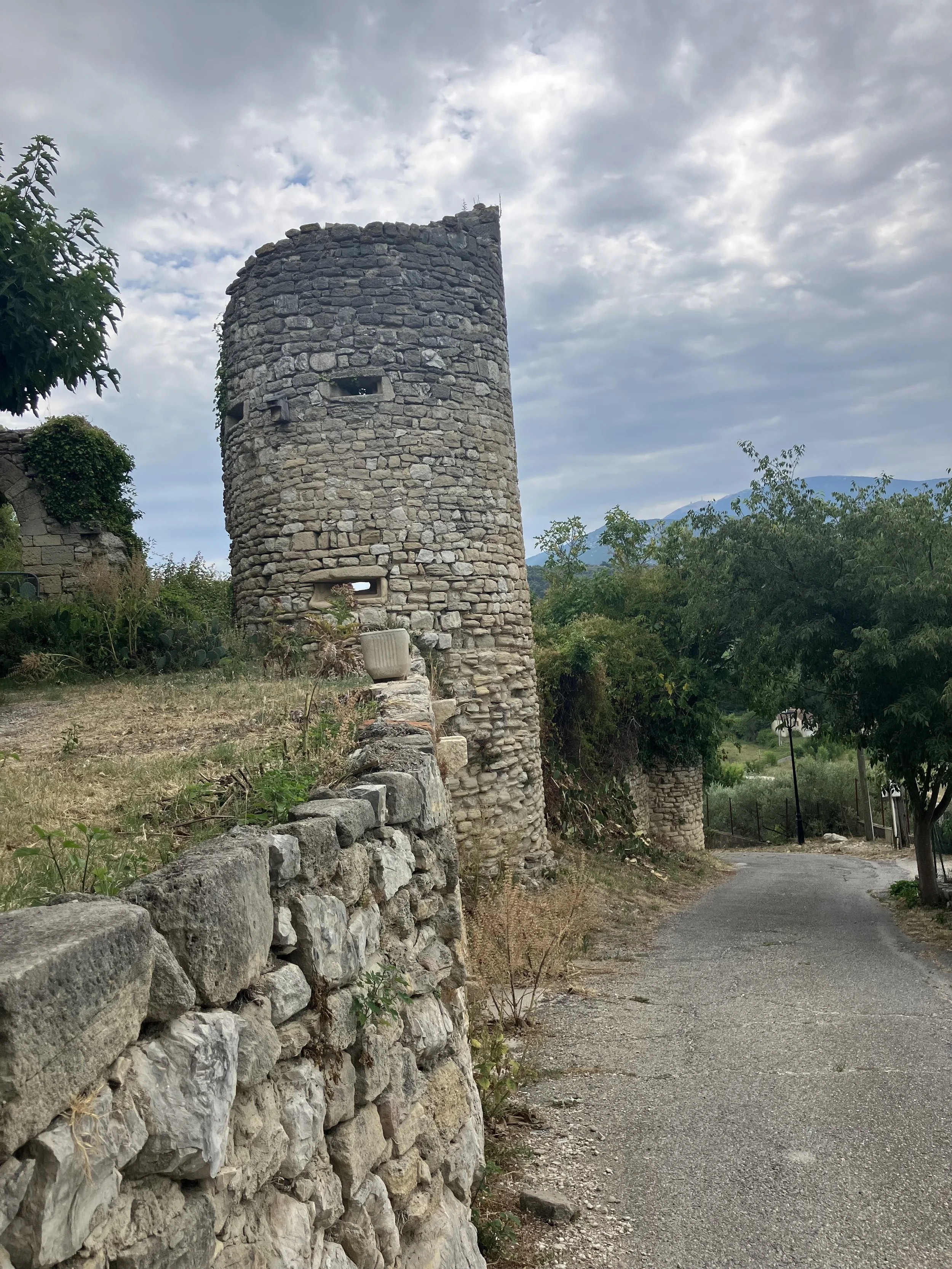
In their place appeared a mix of local scrub and stretches of weathered stone, remnants of the château walls lining the path as the road turned to gravel beneath our feet.
At the top, a centuries-old stone cross stood guard over the sacred, decaying space along with its worn, stone entrance. Stepping through the arch, we spotted cameras mounted along sections of the ancient walls and a mailbox tucked nearby. A modern-looking door and thick-paned windows revealed that someone lived alongside the ruins, perhaps a watchful gatekeeper of this ancient ground.
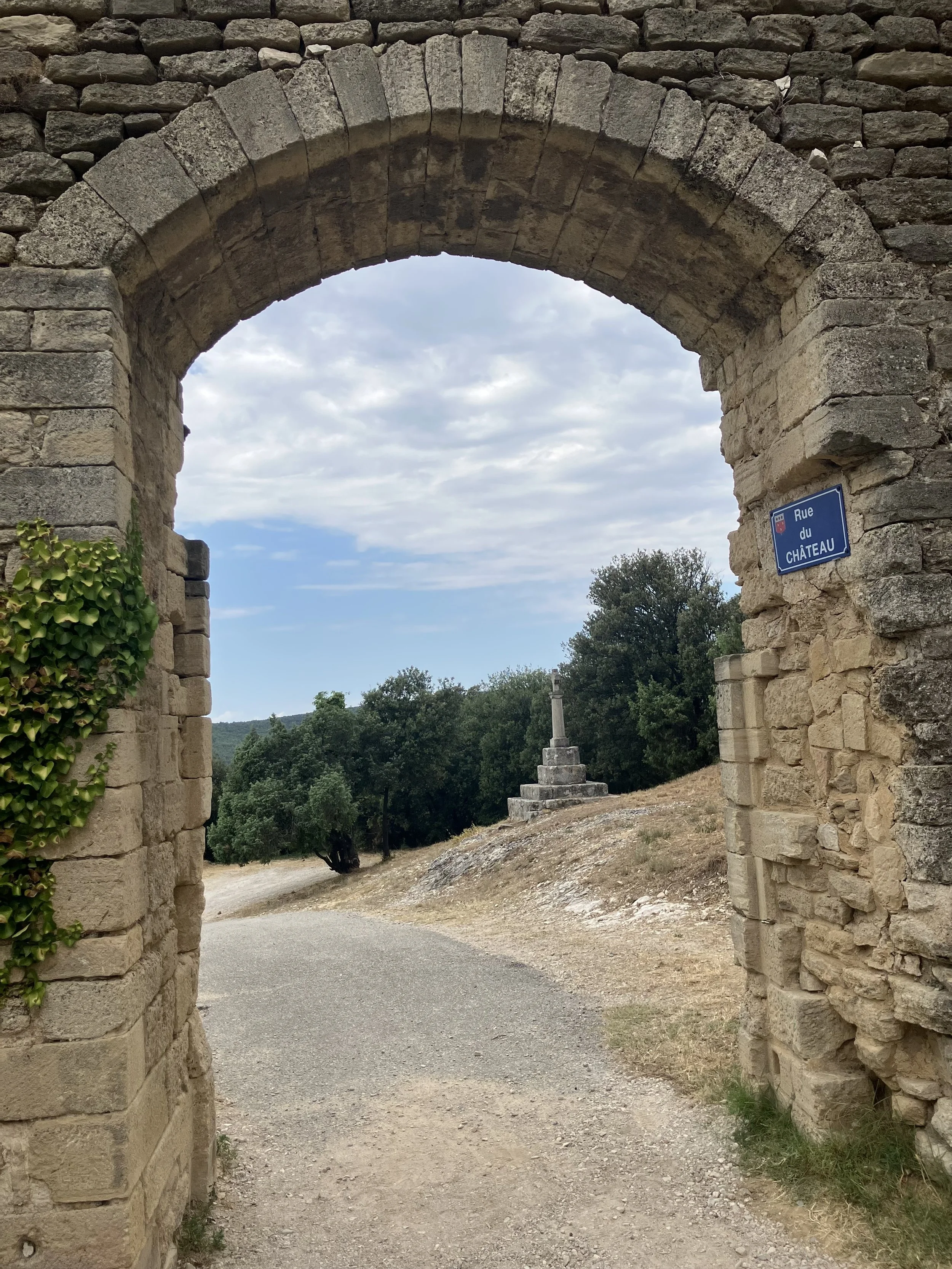
“I think someone actually lives here,” I said, turning to point to the mail box.
“Can you imagine?” He said, turning to take in the most sweeping views below.
“Eh, a little too desolate for my taste,” I said, crunching along the uneven path. As we passed the residence, the compound opened up and another entrance came into view, this one gated and firmly closed, enclosing the crumbling remnants of the château’s interior.
“I know they offer tours during July and August,” I said, turning away from the heavy, rusted gate that barred us from going any further. Andy shrugged, slowly turning in place as he took in the grounds, content to simply stand there and absorb it all from what felt like the top of the world.
I thought back to the moment we first spotted the ruins from below, how imposing they had seemed from a distance. Up close, it was sobering to see them in such a state of deterioration, large sections lost to time and the elements.
Looking past the barred entrance, I noticed the path continue on, sloping down a small hill. Drawn forward, I followed it to the bottom, where a bell tower and church appeared, their pale stone standing in contrast to the rugged ruins above. They felt newer, almost intentionally so, and I couldn’t help but wonder how recently they had been restored, and what stories had been left untouched along the way. Were they used by the owners of the home attached to the castle ruins?
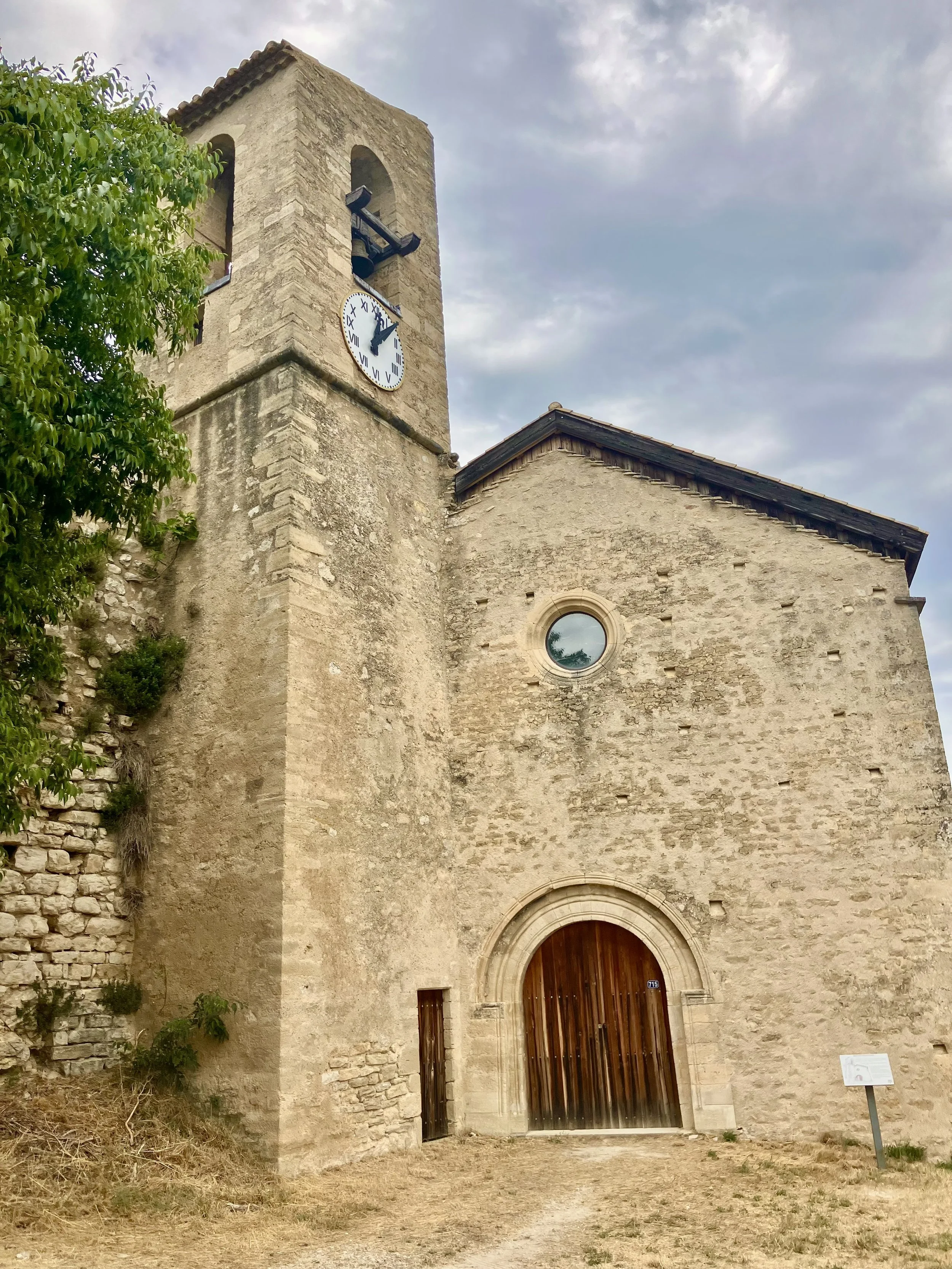
As I made my way back up the path toward the main entrance, I paused one last time, peering through the thick bars for another glimpse of the château’s interior. My heart sank a little as I took in what remained of the once-grand structure.
With a sigh, I turned back toward the main entrance, where Andy was already waiting to begin our descent. As we followed the gravel path, rooftops gradually appeared and the tiny village of Entrechaux began to unfold below. I drew in a long breath, the stillness of the descent easing my nerves and giving me space to collect my thoughts before our first domaine visit.
Beyond the church’s shadow, the road unfolded gently, and within minutes the countryside reappeared, rows of vines stretching outward under the soft gold of the Provençal light. The drive was brief, but by the time we turned onto the gravel track leading to Le Mas des Flauzièrs, the pace had already shifted. The setting felt intimate and unassuming, and within moments, we knew we had arrived somewhere special.
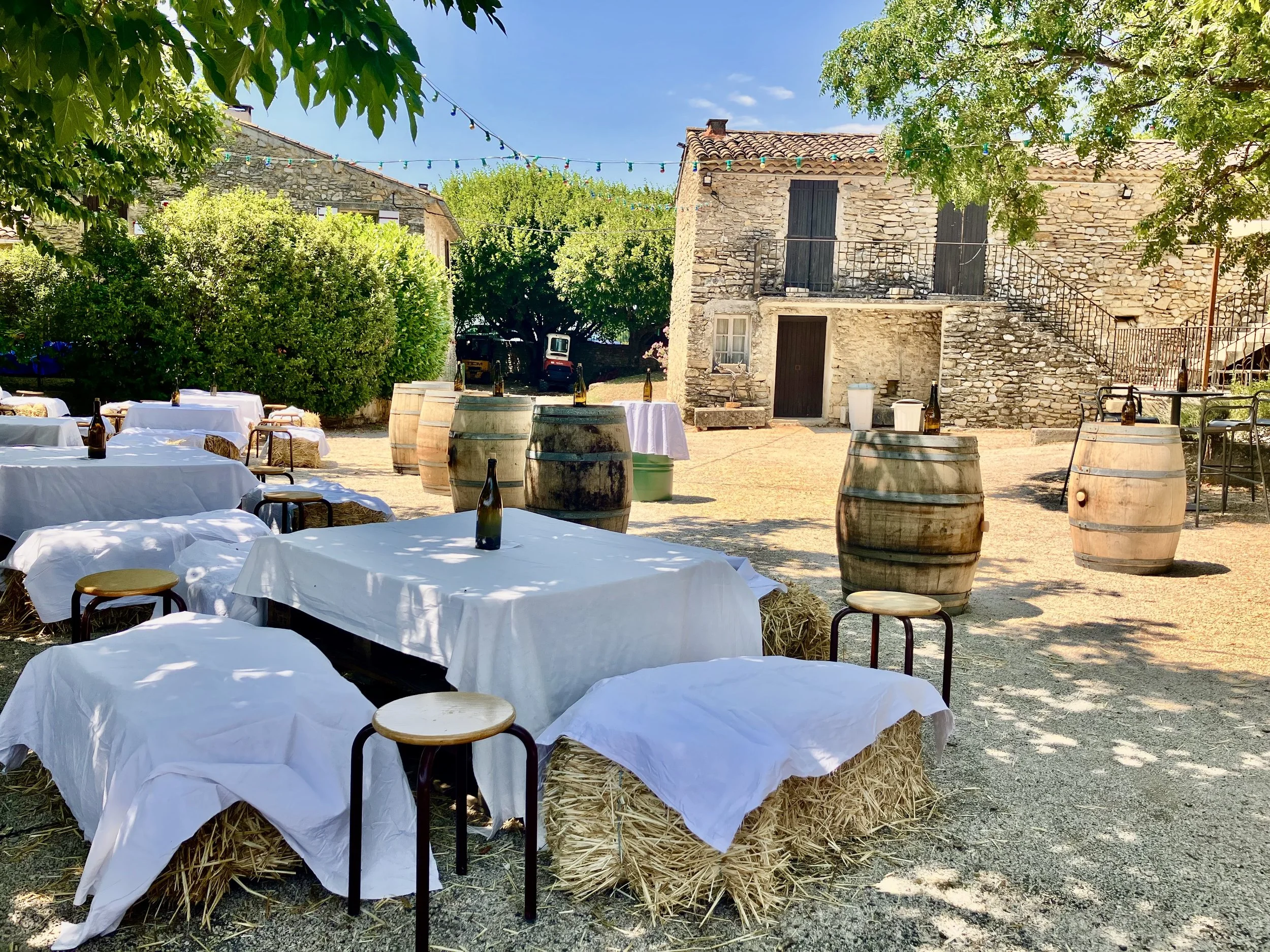
The moment we stepped out of the car, the courtyard hinted at anticipation. Thoughtfully arranged and quietly intimate, it felt prepared for an event yet to unfold.
“What’s happening here?” I asked, glancing back at Andy as we moved deeper into the space.
“I honestly have no idea,” he said.
I was instantly captivated by the space.
The courtyard felt casually staged with strings of lights crisscrossed overhead, anchored to the surrounding trees that cast dappled shade across the gravel. Wine barrels stood scattered throughout the space, some with bottles resting on their surface, others perhaps waiting to be set. Tables had been fashioned from stacked pallets and dressed in simple white cloths, with hay bales tucked alongside them and covered to serve as seating. Everything felt intentional yet unfussy, the kind of setting that invites people to relax and linger.
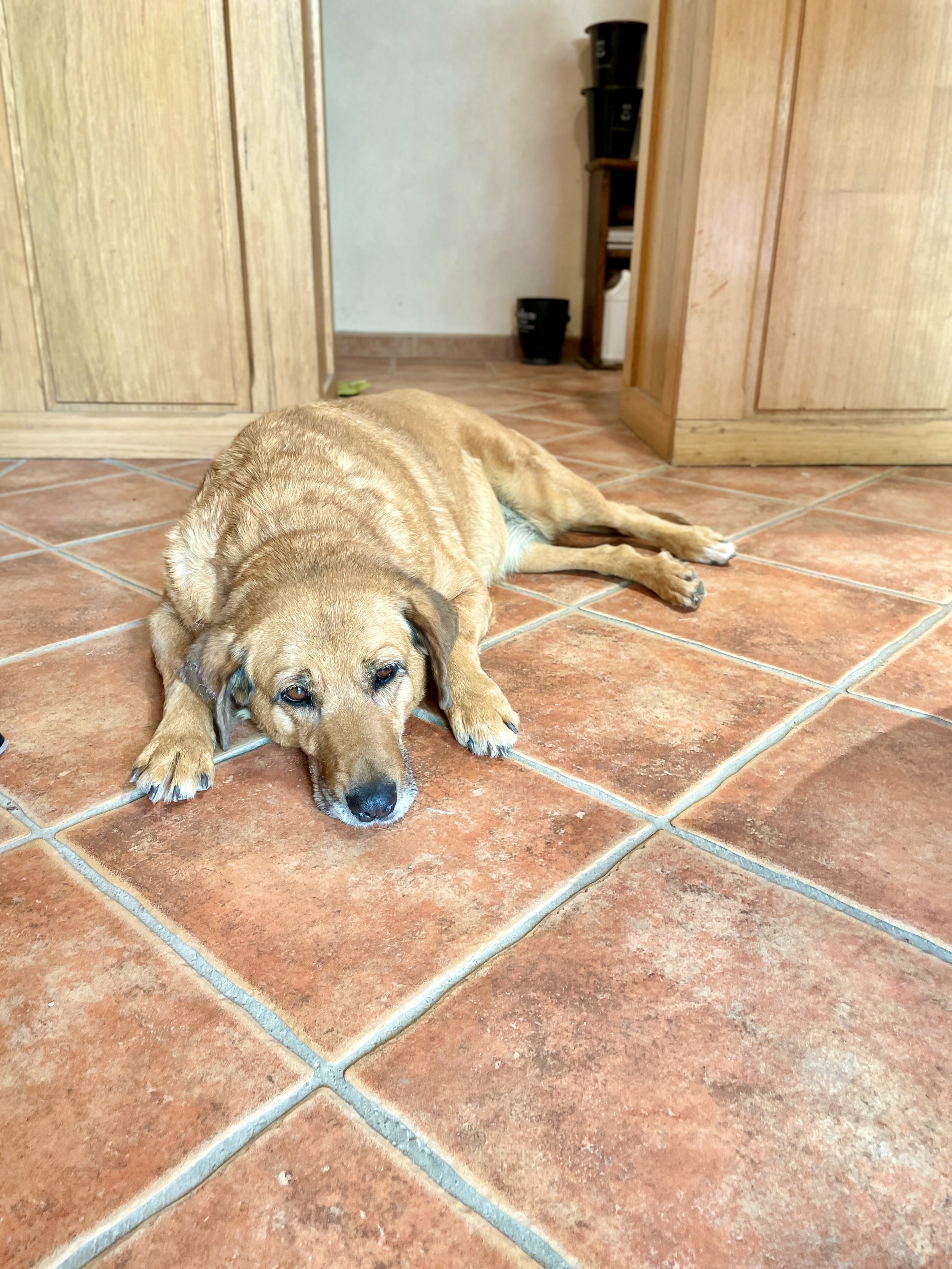
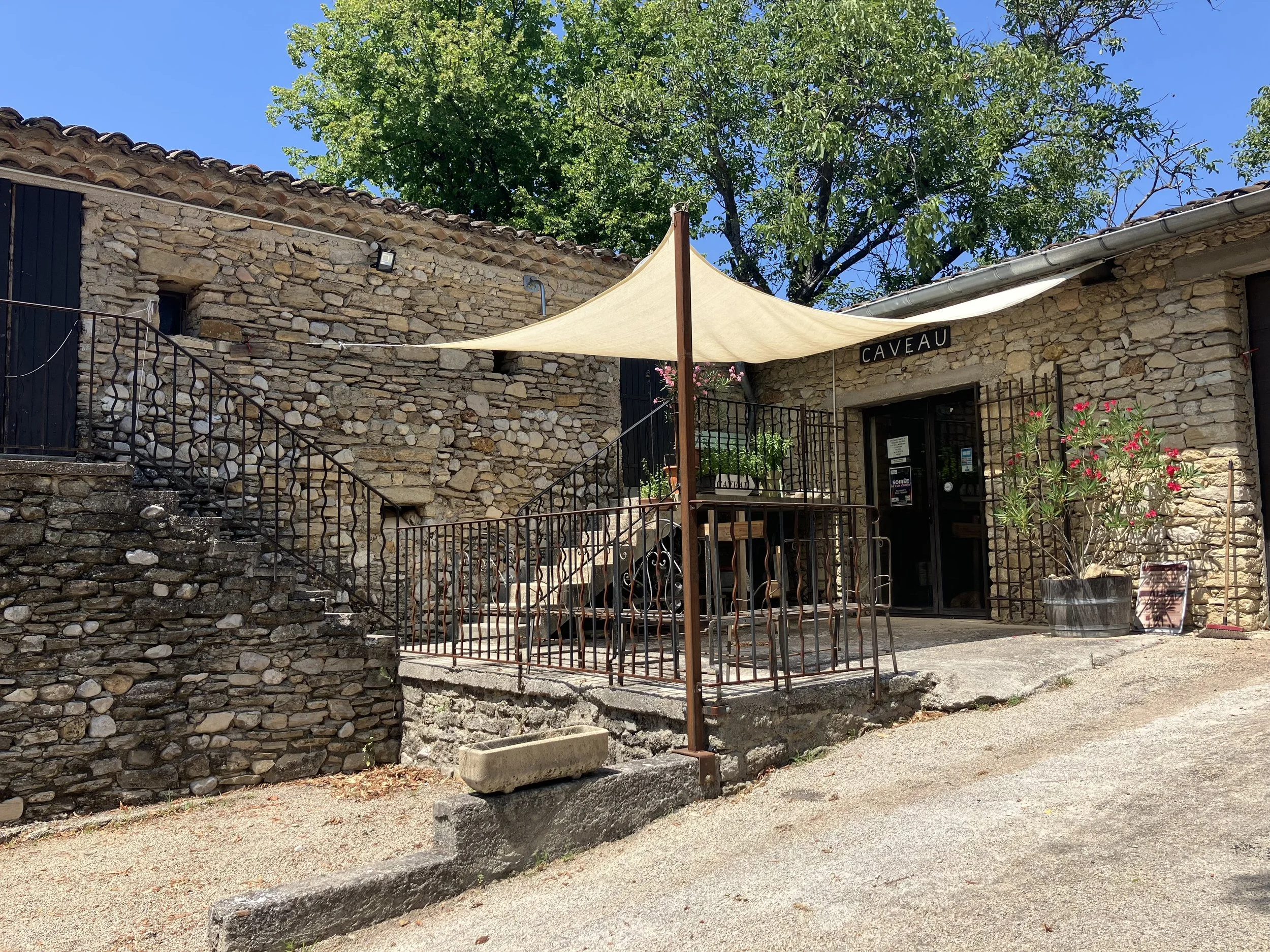
We passed the scene outside and made our way up the ramp, slipping through a door labeled le caveau. Inside, shelves rose along the walls, stocked not only with bottles of wine but also with fruit juices produced on the estate. The soft thud of the door closing behind us was enough to set the domaine’s dog on alert, announcing our arrival before we had the chance. As we paused to greet him, tail wagging enthusiastically, a young girl appeared at the top of the stairs, a stack of papers tucked under her arm. We had clearly interrupted her mid-task.
“Bonjour,” I said with a smile. No matter how many times people have warned me not to smile at the French, it’s an American habit I can’t seem to break.
“Hello,” she called down in a bright, cheerful voice, her tone immediately putting me at ease. Maybe that advice only applied to Parisians after all. “Jérôme will be down in a moment,” she added, extending her hand in a gentle, welcoming gesture that invited us farther inside when she had reached the bottom of the stairs. Once she saw we were settled, she turned on her heels and slipped back up the stairs.
We lingered near the shelves, studying the orderly rows of bottles, light from the small windows catching the glass. A soft echo of footsteps announced Jérôme’s arrival as he descended the stairs, calm and unhurried. The room seemed to settle around him. He greeted us with a firm handshake and a warm smile, seamlessly beginning our visit.
I glanced back toward the courtyard. “What’s going on outside?” I asked, unable to hide my curiosity.
He glanced past me and smiled. “Ah. There’s a soirée tonight with a DJ, a food truck. We do a few of them each summer.” His eyes flicked briefly toward the ceiling. “It’s what my intern has been working on.”
“Your intern?” I asked, suddenly connecting her appearance at the top of the stairs.
“Yes,” he said. “She’s at university studying marketing and needed an internship. It’s good for me.” He laughed softly. “I’m not very good with social media.” As he spoke, he set two tasting glasses on the bar in front of us.
“So,” he asked, “where should we start? White or red?”
“I usually prefer red, he prefers white,” I said, deferring easily. “So you decide.” He reached for a bottle of red and began to pour, picking up his story again without missing a beat.
“My friends tease me,” he added. “They say they can always tell when I’ve posted something myself and when my son has.” I laughed, wrapping my hands around the offered glass. There was something about the way he said it that felt instantly disarming, the kind of honesty that makes you relax without realizing you needed to.
As we moved through the wines, Jérôme shared how he came to speak such fluent English, a skill shaped by time spent far from Provence. After finishing his studies in agronomy and oenology, he set off on an internship abroad, first immersing himself in the wine world in California before continuing on to a second rotation in South Africa. The experience, he explained, broadened not only his language skills but his understanding of the trade itself.
He eventually returned home to Entrechaux and to the family mas, stepping into stewardship of the land, though it wasn’t until 2002 that he formally established his own domaine. The land that the domaine Le Mas des Flauzières sits on had been in his family since 1919, though its story stretches much further back. In the Middle Ages, the land functioned as a working farm tied to the Château d’Entrechaux itself. I thought back to the ruins we had wandered through less than an hour earlier and couldn’t help but smile, struck by how the domaine I had chosen was so deeply intertwined with the very place that had first pulled me back to this village.
It was only after Jérôme took the reins that the mas’s full potential was realized and wine production was brought entirely on site.
He explained that for generations, the harvested grapes left the property to be pressed and fermented elsewhere. It wasn’t until he officially established his own domaine in 2002 that the wine was finally made on site, bringing the entire process home for the first time.
Listening to him speak, it was clear that while his experience was shaped abroad, his roots were firmly planted here at the base of Mont Ventoux.
“My parents would take the grapes to another location to be processed,” he explained, leading us away from the tasting room and swinging open the door to the production space. “I built this to process everything here.”
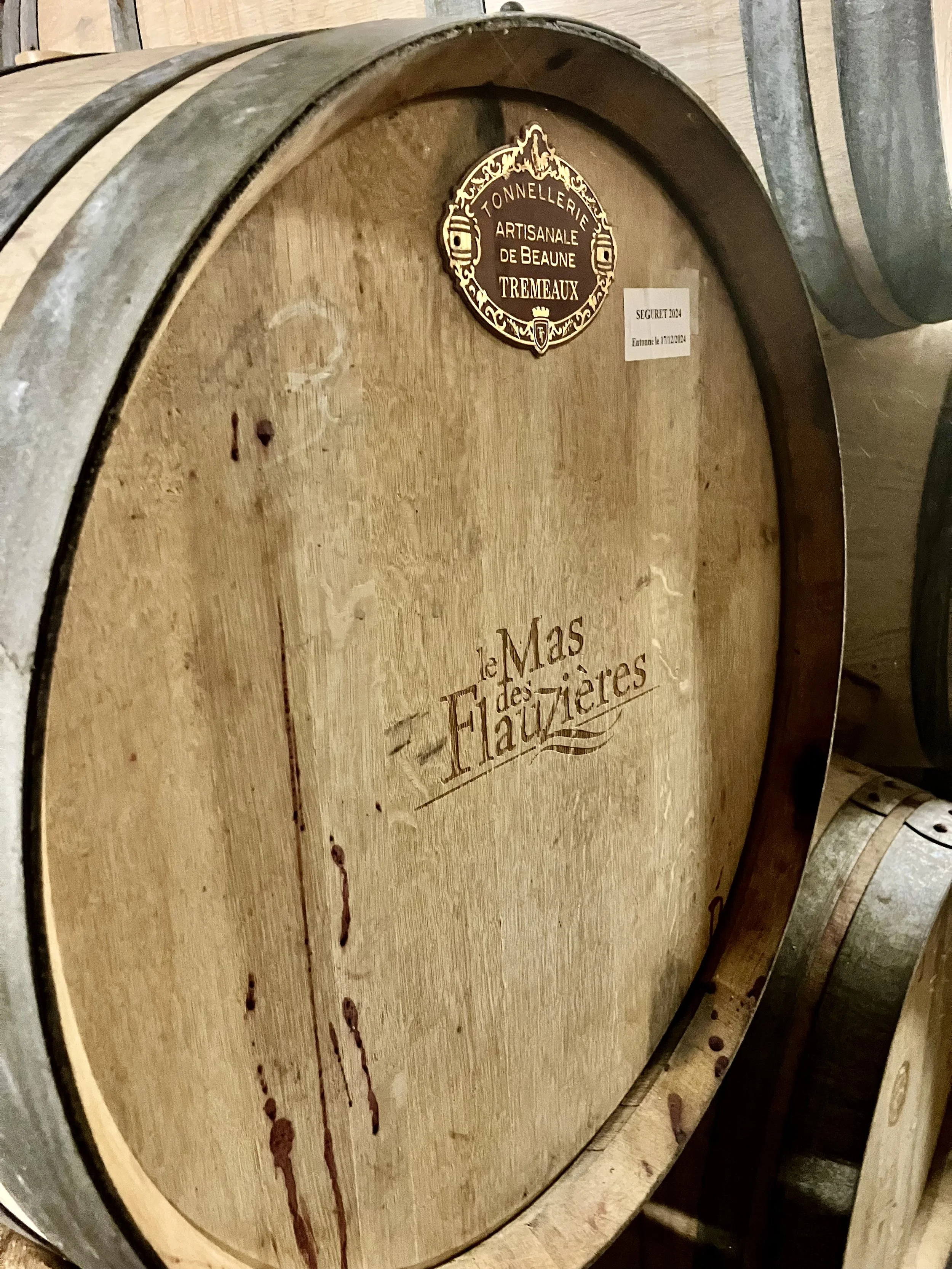
As our eyes adjusted to the dim lighting, the space revealed itself in rows of thick oak barrels lining the walls, each one marked with the name of the parcel where the grapes had been grown. Gigondas. Vacqueyras. Séguret. The names felt like a roll call of the region, familiar and storied, almost like a greatest-hits list written in wood and chalk.
Jérôme rested his hand against a barrel blotched in wine labeled Gigondas. “The vines from Gigondas and Vacqueyras belonged to my grandfather, on my mother’s side,” he said. A moment later, he gestured toward the opposite wall. “The vines here in Entrechaux are from my father’s side.”
And yet, it wasn’t the impressive lineup of appellations that held my attention at Le Mas des Flauzières. My gaze drifted back outside, where the young marketing intern was carefully repositioning a wine bottle balanced atop one of the barrels, adjusting it just so. Nearby, a teenage boy who I assumed was Jérôme’s son, dragged a few hay bales into place, arranging them around a makeshift table built from stacked wooden pallets. The scene felt quietly choreographed, ordinary and meaningful all at once.
In an industry where tradition and legacy carry real weight, moments like this spoke volumes. Jérôme had both, yet nothing about the domaine felt stuck in time or hesitant to evolve. Everywhere I looked, there were signs of a domaine evolving thoughtfully while still honoring the family legacy that came before.
Back in the tasting room, after we’d finished our walk through the barrels and production space, Jérôme made an honest observation.
“The younger generations aren’t drinking as much wine as they used to.” Rather than pushing back against the shift, he told us, he’d chosen to adapt. During the summer fêtes, the mas serves its award-winning wines as well as cocktails made from them, small but intentional changes designed to reach a broader audience. It felt less like a compromise and more like a natural evolution.
I was struck by Jérôme’s adaptability to changing times and the way they affect his industry.
He hadn’t hesitated to bring in someone barely out of university to manage the domaine’s social media, an area he openly admitted was not his expertise. At the same time, he understood exactly what that generation represents for the future of his wines. Rather than trying to pull them toward him, he seemed willing to meet them where they are, allowing the domaine to evolve alongside their tastes. It was a level of awareness I hadn’t expected, one that stayed with me long after we left Entrechaux.
As his son passed through the tasting room, moving quickly between last-minute tasks for that evening’s fête, Jérôme paused to introduce us. He offered an easy smile and greeted us in flawless English, which stopped Andy and I mid-sentence.
There was a note of pride in Jérôme’s voice as he explained that his son had once spent time abroad, living with an American family in Idaho while studying English. What began as a brief exchange turned into something much deeper. The families still visit one another from time to time, welcoming each other’s children and occasionally the entire family.
As his son returned upstairs, Jérôme explained that in the midst of the fête preparations, his family would be making a trip to the airport. The Idaho family was arriving that very day to stay with them for a brief time.
As we finished the last wine of our tasting, late morning had slipped into early afternoon. Sunlight stretched across the tasting room floor while preparations for that evening’s fête hummed softly around us.
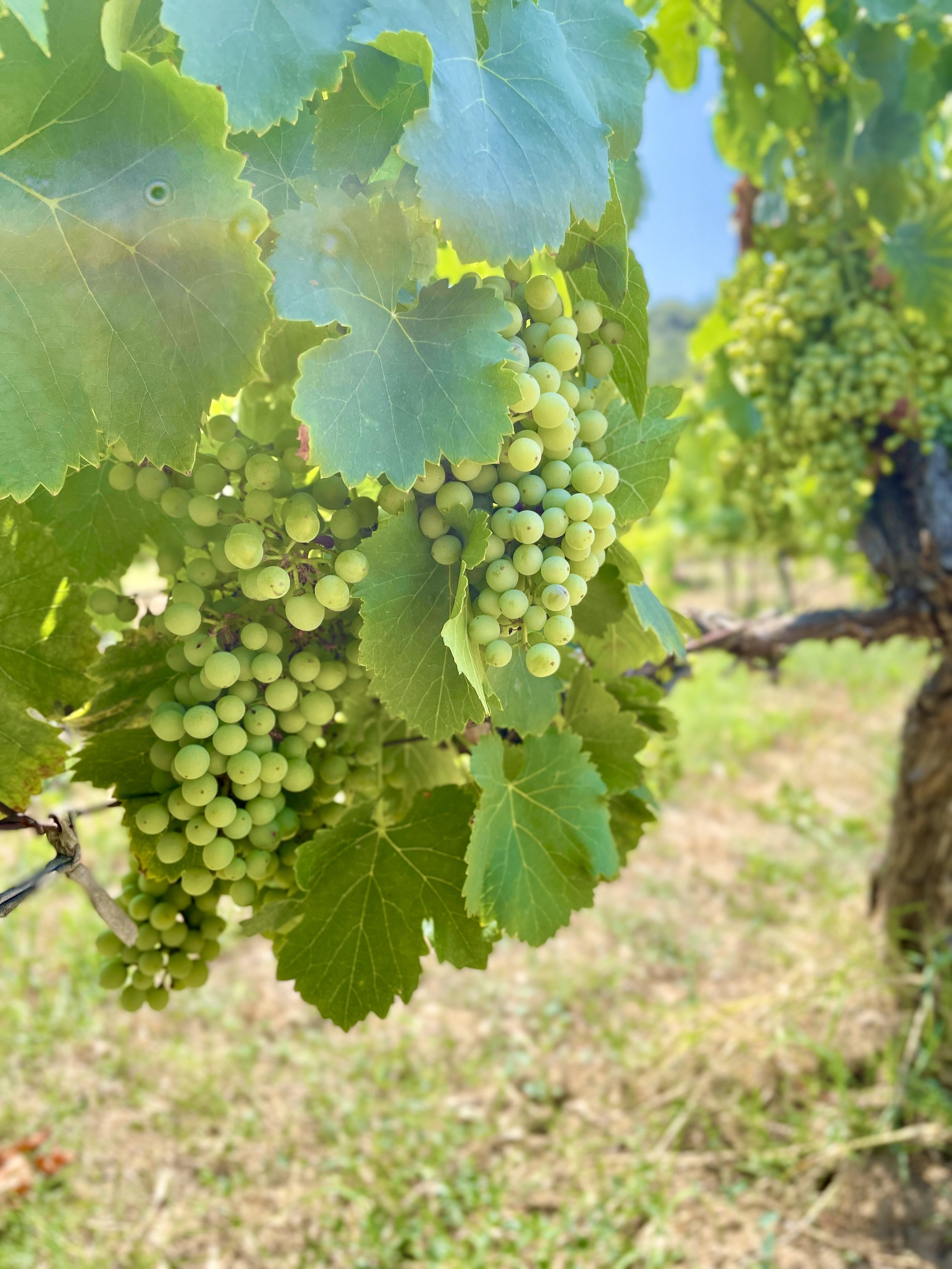
We had explored the production space and tasted through the wines. Before we parted, Jérôme led us outside to the edge of the vines. The leaves shimmered in the same golden light that had first revealed the château months earlier. He gestured toward the rows stretching beyond us, grounding everything we had just tasted in the soil beneath our feet. Standing there, between ancient stone and living vines, I understood more clearly what stewardship means in this place.
As we pulled away from the mas, gratitude lingered. Jérôme had allowed us into more than just his tasting room; he had welcomed us into the quiet mechanics of his craft. The experience shifted something for me, opening a deeper curiosity about the lives and labor behind the wines of this region.
Despite this being my first visit, it set the tone for the series, uncovering the blend of heritage, patient labor, and generational care that gives these wines their soul.
Visit Le Mas des Flauzièrs
Visiting Provence and hoping to enjoy a wine tasting?
The Benoît family would be delighted to welcome you.
10 A.M. to 12 P.M. and 2 P.M. to 6 P.M.
Monday to Saturday (May 01 to September 30)
Monday to Friday (October 01 to April 30)
Otherwise by Appointment
Address: Route de Vaison Romaine 84340, ENTRECHAUX
Closure From December 25 to January 31, holidays and Sundays
Visits are offered in both English and French, making the experience easy and enjoyable for all visitors.