A Visit to Domaine des Girasols
The visit that felt like a fuzzy sweater on a cold, winter day.
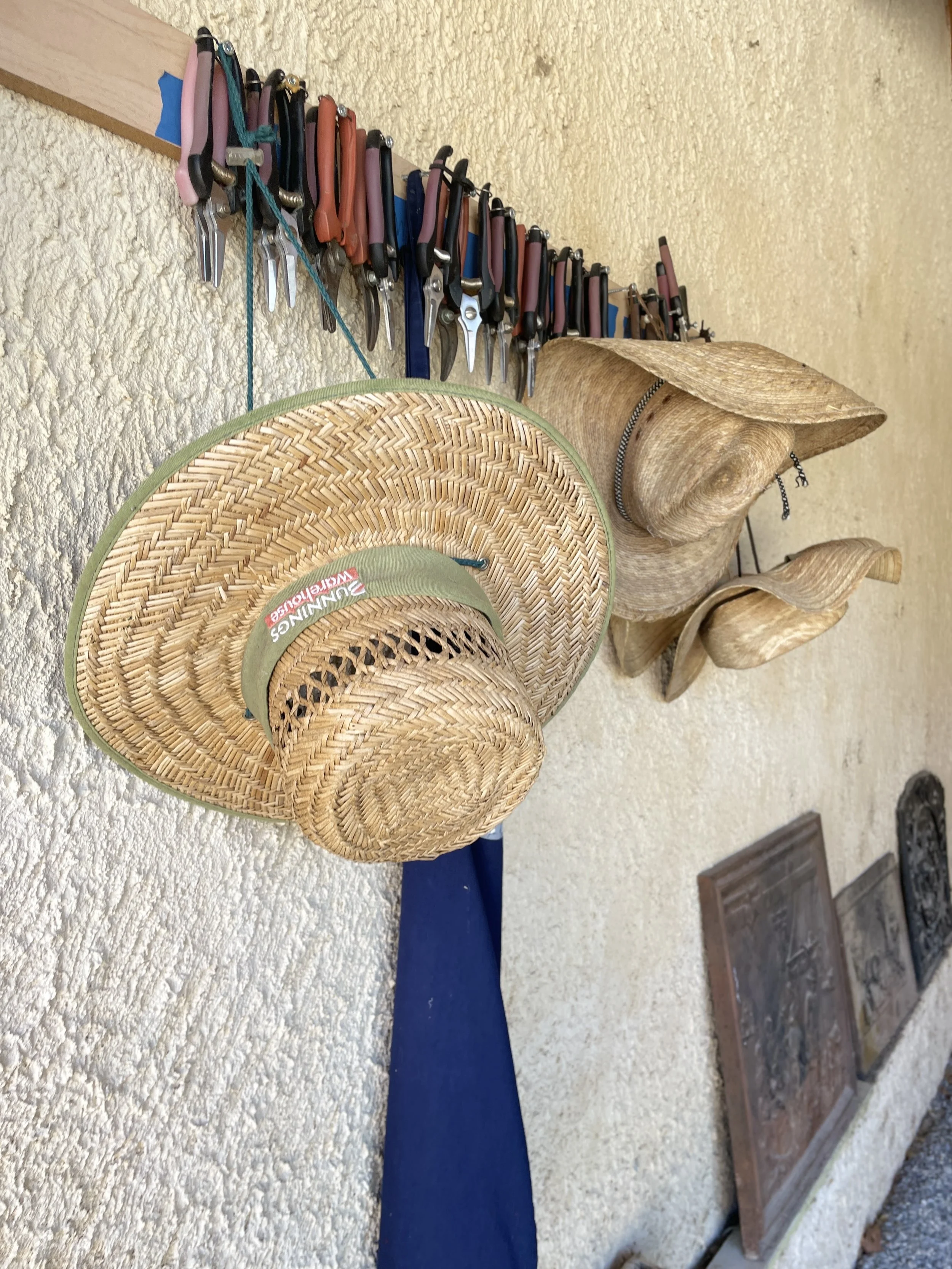
When I returned to Provence, I was especially happy to reconnect with Dana, whom we had bought our house from in Vaison a few years ago. She had settled back into the region with her son and was living in the next town over. This meant we could easily catch up, whether over a long lunch at a shaded café or with a glass of local, Provençal wine. There is something about this region that makes time stretch, and our conversations seemed to settle into that rhythm, unhurried and warm, much like vibe of Provence itself.
During one of those outings, Gillian, a fellow American and longtime friend of Dana, joined us to soak up the sunshine and easy conversation. It was over the hum of the café around us during that leisurely déjeuner that the two grew curious about my blog, asking questions and even offering ideas for future posts. Usually, I’m a bit shy when talking about my writing with people who live nearby. Digging into the more personal parts of Andy’s and my life in France can feel deeply intimate and, though I post those stories for the world to read, they often feel like they’re meant just for me, a sort of time capsule of our expat journey. I’ll admit it, when someone asks about my website or the blog, I still get a little shy. I’m not an expert on this region of France, so sometimes I catch myself wondering what gives me the right to write about it so closely and personally.
It wasn’t until the Postcards from Provence series that I even began mentioning people by name. I’ve always tried to honor their privacy and respect their autonomy. The last thing I would ever want is for someone to question my intentions or feel that a genuine moment shared with me was turned into content for others’ entertainment.
But something about their interest felt genuine and kind, and I found myself opening up about my newest project. I explained that, this summer I wanted to really allow myself to honor the region we are slowly integrating into. When you drive down any road through Provence, you will see many signs, some homemade and small, others bigger and more professionally made guiding visitors with arrows to a dégustation, or wine tasting, at a local, family run cave.
“Our first summer here, we knew we wanted to get more engrained in the wine culture,” I explained to my eager audience, intently listening as they enjoyed bites of their salads.
“But we really had no idea what we were doing. I googled “wine tasting” and, of course, the most commercialized, corporate-owned locations flooded my results page. I could make a reservation online with an English-speaking tour guide and, after a few clicks, had booked our first wine tour in Provence.”
Looking back now, it is actually so embarrassing to recall that particular visit, but, we really didn’t know any better and we were doing what we thought others did when wanting to try the local wine. We truly had SO much to learn!
Each summer, however, we felt more comfortable not only in our surroundings, but also with the specific language needed to go on a true, Provençal dégustation.
This past year, I was ready to take it a step further and write a small series on the true backbone of the Provençal wine scene. The smaller, family-owned domaines that dot the hillsides all around the South of France and make Provence one of the most notable wine regions of the world. The piece would spotlight a handful of hidden-gem domaines, the kind of places you’d never find unless you lived here. And while my series features only six caves out of the literal thousands, my goal was to show how accessible these small estates truly are for travelers to the region.
I genuinely believe that part of the reason visitors flock to the big-name producers is simple: fear of the unknown. I can say from personal experience that this is exactly why I avoided the smaller domaines for so long. The idea of driving up to a family’s estate and simply walking into their tasting room, especially without a reservation and with the worry of committing a faux pas, felt intimidating, even paralyzing.
But the truth is, many of these places want visitors. They have open hours specifically for walk-ins, and they’re more than happy to welcome guests for a tasting and a look around.
The girls nodded, as if to say they understood completely. For anyone who isn’t from here, the thought of navigating a dégustation, especially without knowing the unspoken etiquette, can feel a bit overwhelming.
I suggested they carve out some time in their schedules to join me for one of my tastings. Over the past few weeks, I had arranged visits with six unique, family-run domaines for a piece that felt almost too important to write. In Provence, as in much of France, wine is not just something you drink; it’s a living expression of heritage, pride, and identity.
These family domaines work ten times harder than the big commercial producers, pouring generations of dedication and passion into every bottle they produce. I wanted to honor that commitment, and I hoped the girls would get to partake in it firsthand.
But, even after visiting each domaine, I spent weeks reflecting on the information I had gathered. The visits had been so personal, with each family sharing their life’s work and passion, that I felt a responsibility to honor their stories and convey the visits with the care they deserved.
Gillain’s schedule was a bit more flexible than Dana’s, so we decided she would join us for our visit to Domaine des Girasols, just one town over from her home in Rasteau.
The Domaine is perched atop one of their many hills of vines on the outskirts of the beautiful village of Rasteau. When we arrived at the family residence, which also serves as the tasting room and cellar, we were immediately struck by the absolutely stunning views. The Domaine is nestled between the Dentelles de Montmirail mountain range and Le Géant of Vaucluse, Mont Ventoux, offering a panorama that most people only see on postcards. Once we finally managed to step back from the view, we were greeted by the family dog, who promptly scampered over to ensure we were properly greeted. As a dog lover, I always notice how a wandering dog adds a warm, homey vibe to a place, and here, it filled the space with an easy, welcoming coziness.
Soon we were greeted by two men, one in a tie-dyed T-shirt and cutoff jeans, a look you don’t often see in rural France. Both extended their hands for a firm, enthusiastic handshake, another gesture that felt decidedly un-French. The men introduced themselves as Jon and his son, Julien, explaining that they’d been unloading decorations for Julien’s western-themed birthday party the following night. Bails of hay sat around the parking lot along with barrels and other decor.
Within moments, we found ourselves pulled into an easy, friendly conversation. It didn’t take long to understand why their energy, their clothing, and even their greeting felt so familiar: Jon was American, and Julien and his sister had spent much of their childhood in the U.S. Suddenly, their flawless English and open, chatty style made perfect sense, traits people usually associate with outgoing Americans. Anyone who has spent time in France knows that small talk isn’t typically part of the cultural rhythm; the French tend to prefer quieter moments and more meaningful conversation.
After it was discovered that he was, in fact, American. Jon explained that he and his French wife, Françoise, whom I had been communicating with via email leading up to our visit, had met while they were both working at Joseph Phelps Vineyards in Napa Valley, California. What was meant to be a brief six-month internship for Françoise turned into a year when she requested a visa extension so she could stay a little longer. Not long after that extension was granted, Jon arrived to work on a project involving mislabeled bottles, a coincidence that ended up shaping both of their futures and making for an incredibly charming story. The two split their time between Jon’s home state of California and Françoise’s village of Rasteau before settling full time in France to take over the domaine in 2008.
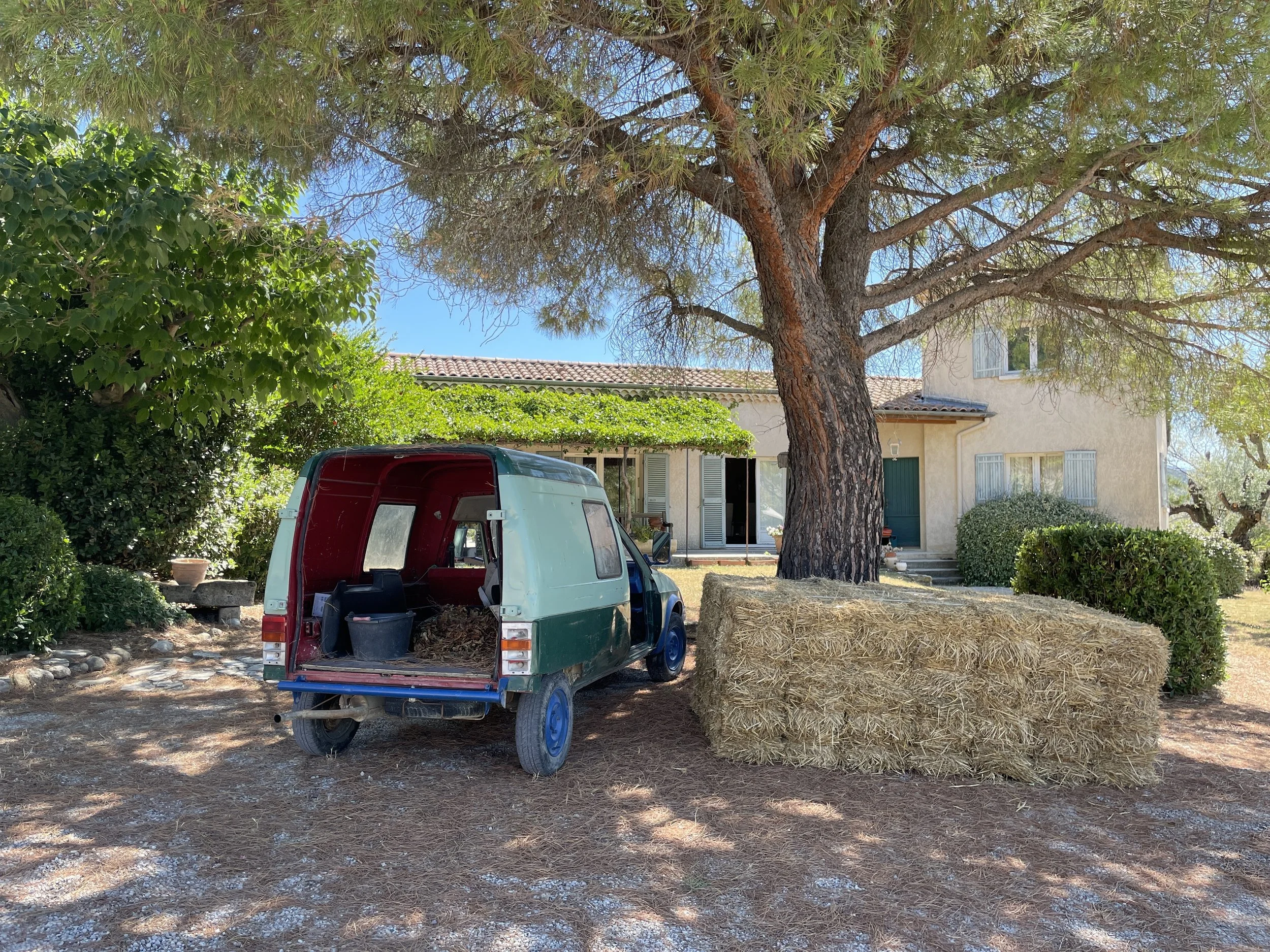
Some props for Julien’s birthday party.
Looking past the duo, we noticed an older couple sitting on the porch, enjoying the fresh morning breeze before the heat took over and they had to seek out cooler temperatures inside. These were the original owners of the Domaine, Françoise’s parents, Paul and Marie-Élisabeth. There was something absolutely endearing about the fact that they still watched over their vines, despite being retired and passing the Domaine to their daughter and Jon. It was the 70’s when her parents bought the vines, which were originally planted in 1912, and started Domaine des Girasols.
Françoise appeared from one of the building and we said our goodbyes, allowing John and Julien to continue preparing for the birthday celebration while we followed François into the tasting room/workspace. The space was an eclectic mix of treasures from the past and bottles of their current vintages, displayed along the back wall.
As soon as we entered, Gillian’s eyes went straight to the beautiful quilt hanging proudly along a wall, for all to see.
“I’ve been here before,” she said, walking directly over to it and admiring the detailed pattern and colors. “I was here for a quilt exhibit,” she said.
“Ah, yes,” Françoise confirmed. “We have had those here before in the other space,” she pointed through an open door to a room filled with boxes upon boxes of wine. “We would have them in the summer months usually. The last one was in 2019,” she said, walking over to the quit.
“They were all of my mother’s friends who made the quilts, but all of the quilters have gotten older. I’d love to do another one, but I wouldn’t even know where to find quilters to showcase,” Françoise added with a hint of melancholy. She paused, then gently lifted the corner of the hanging quilt.
“This was the last quilt that my mother made.”
They both stood for a moment, gazing up at the beautiful piece.
“It’s even featured on one of our top selling wines,” she said, pointing back to the wall of wines behind her. There was one that stuck out amongst the others that had a swatch of the quilt at the top of the label, highlighting the domaine name for all to see.
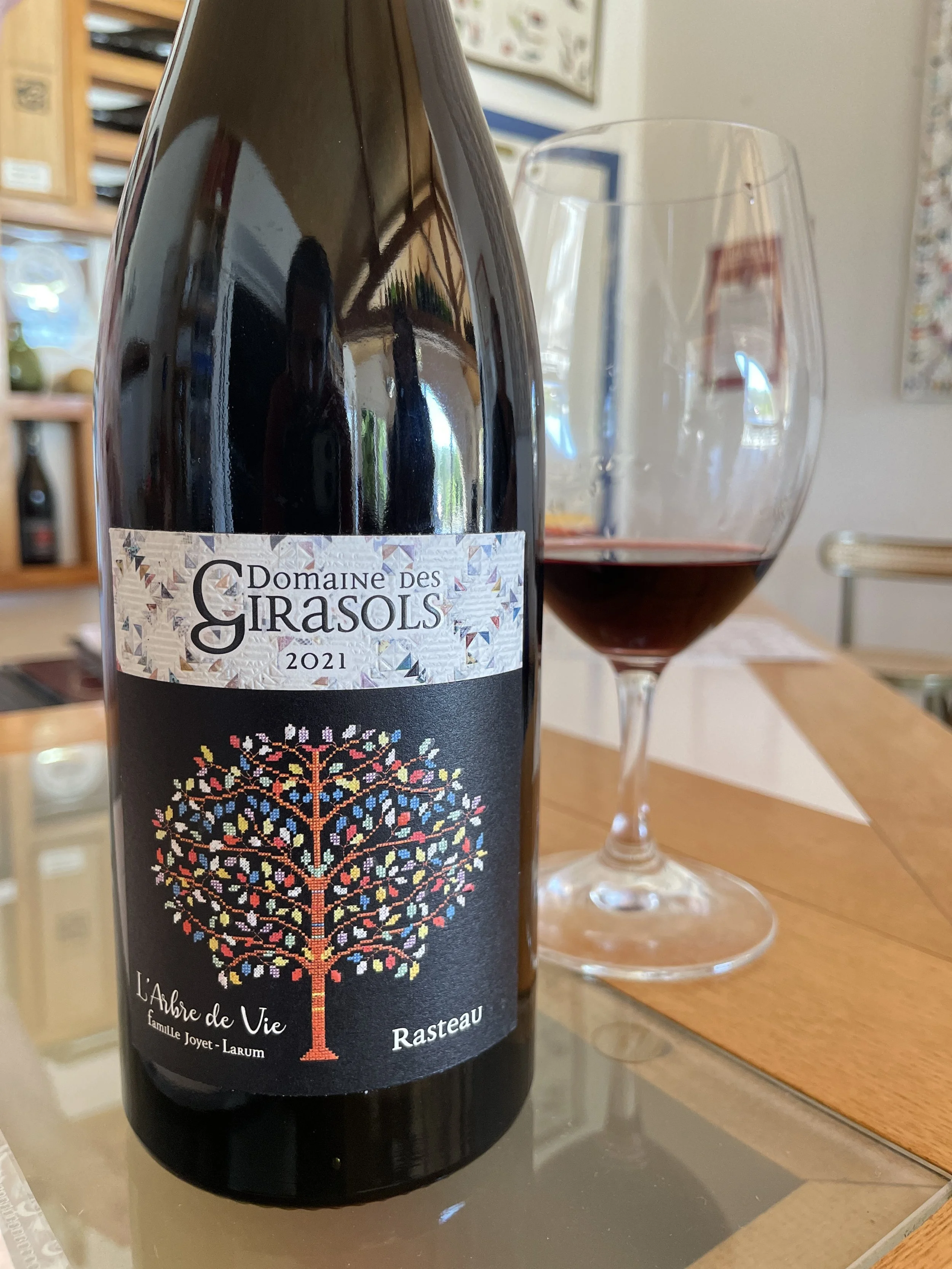
“The bottom is a cross-stitch completed by my late sister, Catherine. The label was created in memory of her,” she explained, her voice warm with memory.
The label was so much more than a sticker announcing the wine’s name. It was the perfect blend of generations of women, their artistry woven together. On the outside, Marie-Élisabeth and Catherine’s tapestries brought their creative legacy to life, while inside, Françoise’s care and devotion shaped the grapes at the heart of the blend. In that moment, it felt like so much more than a bottle of wine. I felt honored not only to know the story behind the label’s creation, but to sit in their tasting room and share a glass of it, a true expression of their family’s passion, devotion, and legacy.
Françoise gave a small nod, excusing herself from the quilt and took her place back behind the tasting area where she immediately began setting up wine glasses along the worn, wooden bar top. “What would you like to start with?”
Jillian and I looked at each other. Though this was my third domaine visit for my series, I still felt a bit out of place when visiting.
“I prefer red,” I said with a small, indifferent shrug as Françoise turned to face the wine rack and collect the first few bottles to taste.
With every pour, she shared another story, weaving her family’s history into each glass. It was unlike any tasting I’d been to up to that point. Rather than a formal experience, it felt as if we’d slipped into her home and taken a seat at her kitchen table, welcomed like old friends.
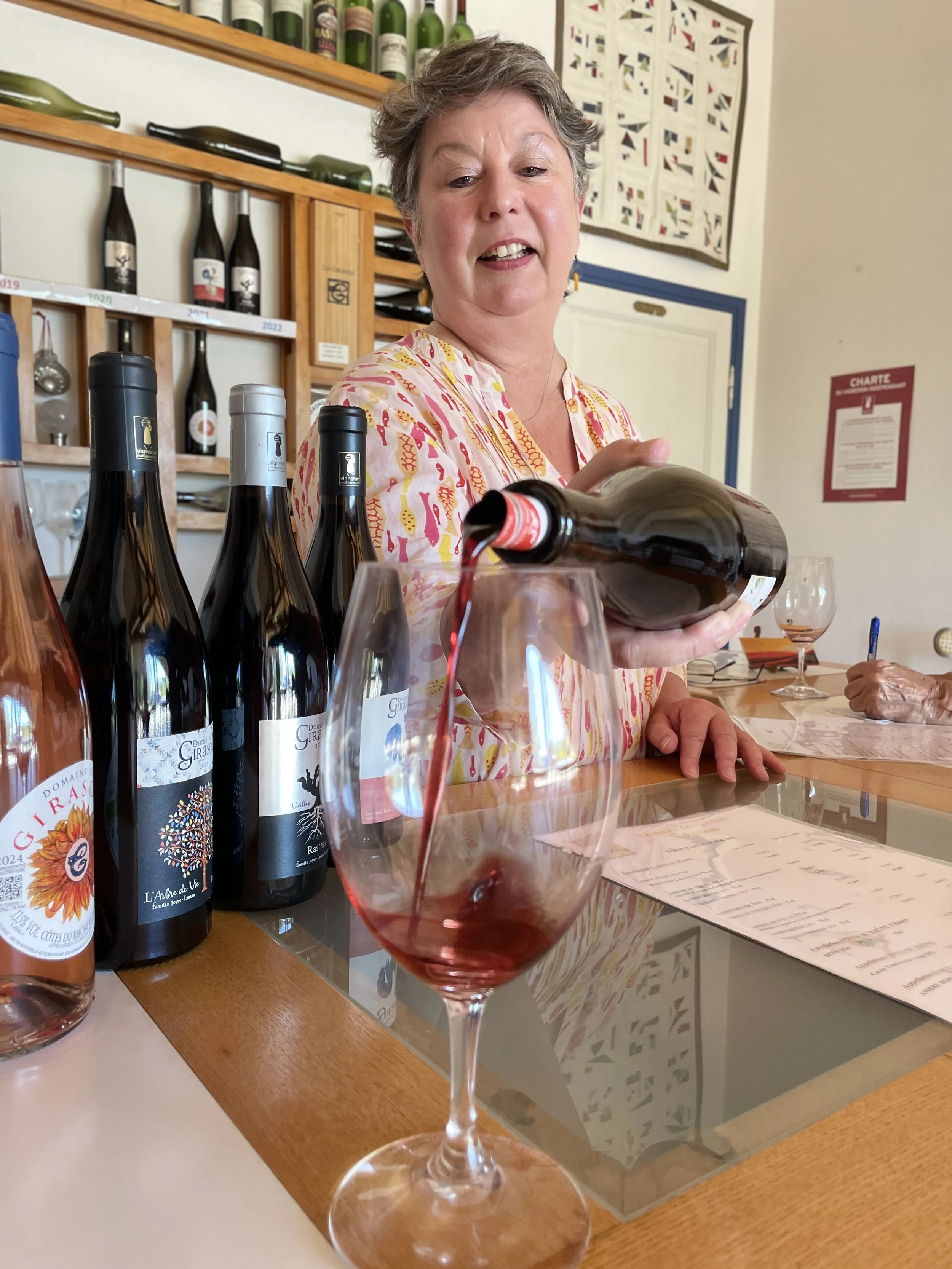
François serving us a glass of their red.
“So, Julien is here with us, but Pauline is in the United States. She is working as a sommelier in New York,” she said, beaming with pride.
“It must add an extra layer of credibility to her work to have your family own their own domaine back in Provence,” Jillian added.
“Absolutely,” Françoise agreed.
“You know Jon is from California,” she said with a curious smile. “What do these colors remind you of?” She asked, placing a finger between the color divide on the currently open bottle’s label.
We each took a closer look.
“Isn’t this the color of the sports team?” Andy asked.
“Do you remember which one?” she asked, encouraging us to keep guessing.
“We aren’t exactly an athletic bunch,” I joked, giving Andy a look to nudge him along.
“Was it the football team?” he guessed.
“That’s right! The label is a nod to the Raiders football team, now in Las Vegas. Jon has been a fan since the ’70s, back when they were in Oakland. Their colors were silver and black, which is why he designed the label to look like this.”
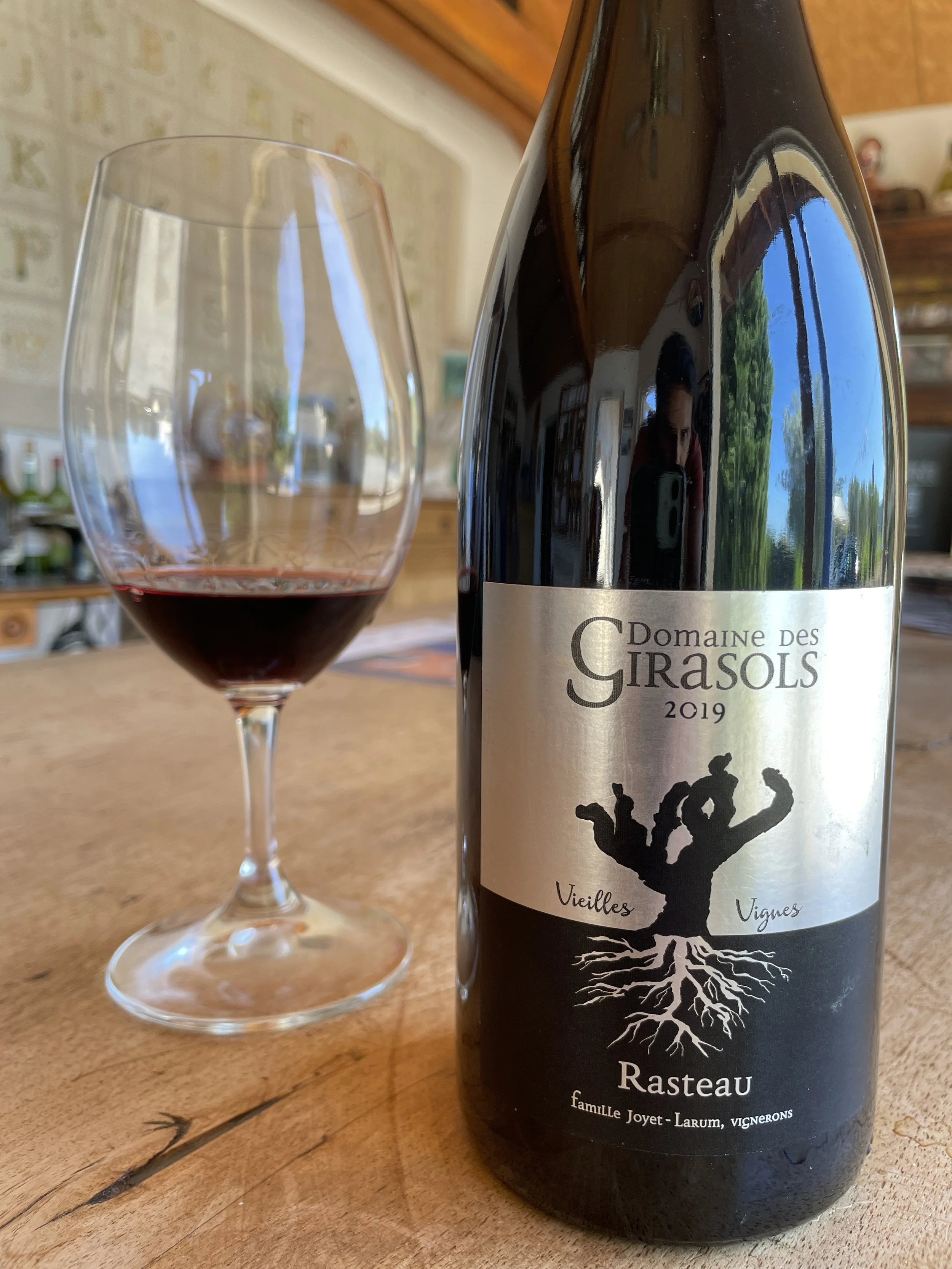
“Jon created this label?” Andy asked, turning his attention to the other detailed and eclectic bottles lining the shelves behind Françoise.
“Yes, Jon has created many of the labels. He’s very creative and has a lot of ideas, I like to say, when you are in the vineyards for months to prune the vines, you have time to think about stuff …”
She turned to face the wall again, grabbing another bottle of red with a colorful label.
“This bottle, Lampereuse is a label he designed with his good friend Kevin. The rooster is one of the emblems of France and it’s on a barrel because half of the wine is barrel-aged. The rooster has the colors of reggae because Jon loves reggae music,” she turned the bottle so that the bottom of the label was more prominent and pointed to the leg of the rooster. “There is a french flag here because the label came out in 2018 when the French football team won the World Cup,” she said, tapping the spot for emphasis.
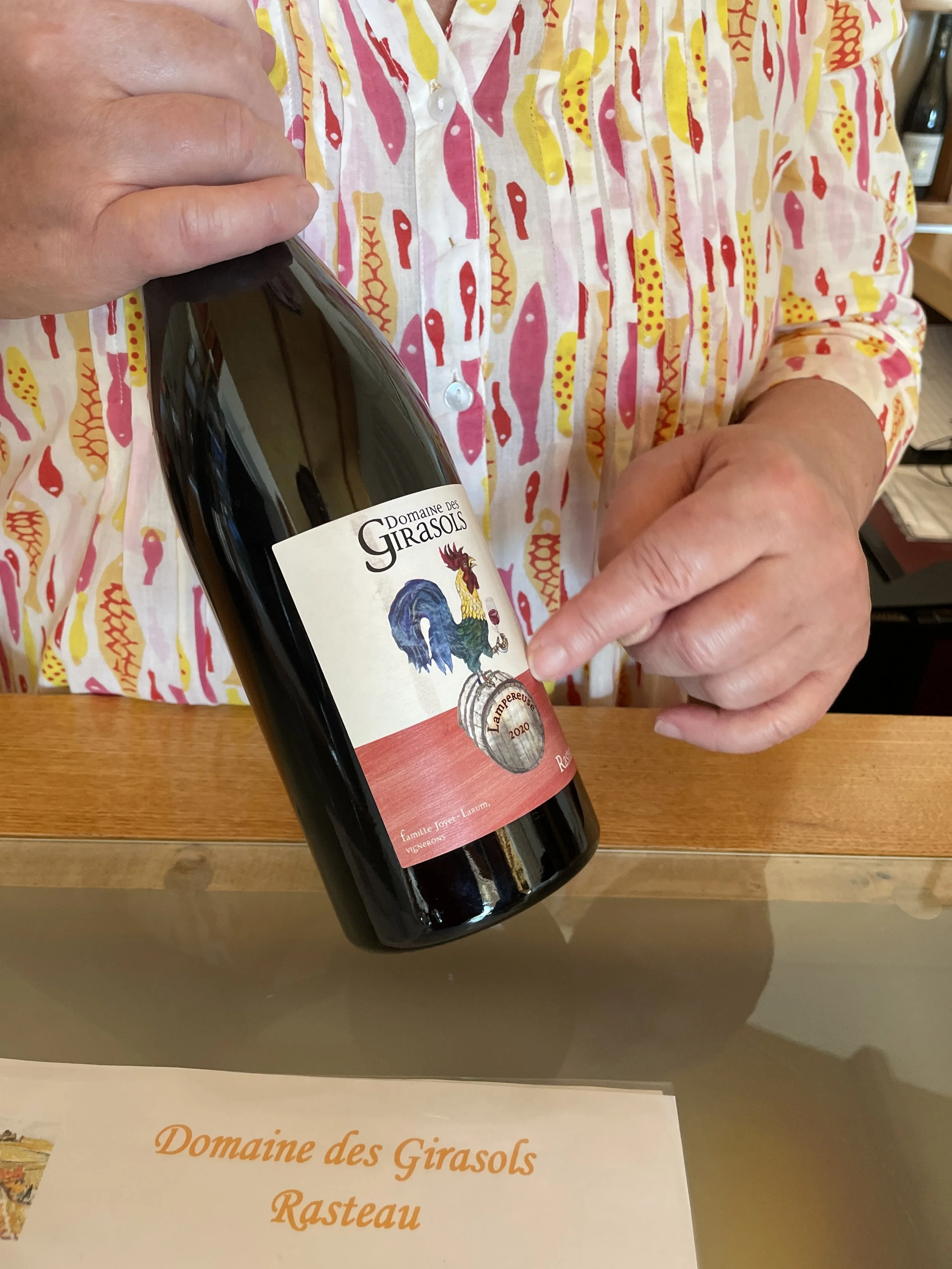
So much time, care, and thought had gone into these labels, from the colors to the smallest design details. It made me think about how many times I’ve picked up a bottle of wine and poured it without giving the label a second thought. How many hidden messages and personal meanings had I overlooked in the past?
As an outsider visiting these domaines in hopes of better understanding the inner workings of small-production winemaking, I’d already gained a new appreciation for the love and care poured into the wine itself. But this was the first time someone had drawn my attention to the outside of the bottle. These families were invested in every step of the process, right down to the labels and what they choose to project to the world about their heritage, their life’s work, and their craft.
As Françoise uncorked another bottle for us to try, Jillian and I tipped what remained of our previous sample into the dump bucket.
“It’s almost too good to dump out,” Jillian said tipping her glass, “but if I drank all of it I wouldn’t be able to drive home.”
“I know, I have one full glass and I’m done,” I said, steadying my glass for the next round.
“Don’t worry about that,” Françoise assured, waving her hand for emphasis. “I use all discarded wine to make my own vinegar.” She turned the next bottle so the label faced Jillian and I.
“Wait, you do?” I said, surprised, yet completely intrigued by her comment.
“I wanted to make sure the wine didn’t go to waste and it is the base for vinegar, so I use it to make vinegar and then bottle it up and gift it to people,” she said, nonchalantly.
“I will make sure to give you one before you leave,” she said, beginning to pour the freshly opened wine.
“We would love that. We both love to cook,” I added, taking the new glass of wine in my hand to get a closer look.
“If you like to cook,” Françoise started before disappearing under her counter, “you will really like this,” she finished as she reemerged and held out two little books for Jillian and I to take.
“Wait, what is this?” I said, beginning to flip through the pages.
“A recipe book that specifically uses Rasteau Vins Doux Naturels,” Françoise answered, grabbing a bottle of amber liquid from the shelve.
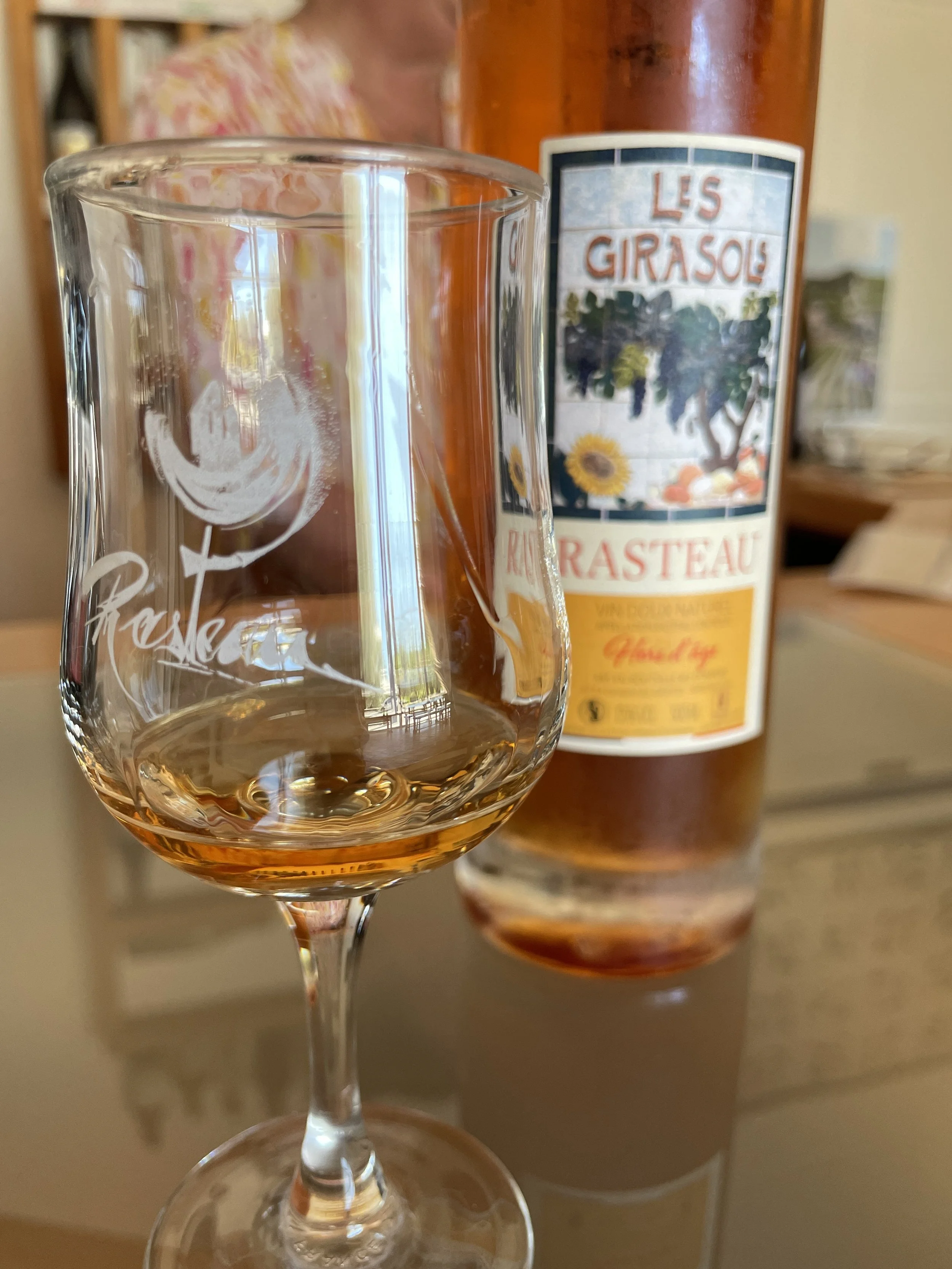
“The village of Rasteau has its own naturally sweet wines, made by many of the domaines around here. You can find them in red, white, or an amber color. The book includes recipes that use the wine as an ingredient, as well as dishes that pair beautifully with it,” she explained, a note of pride in her voice.
“I had no idea that Rasteau had their own version of sweet wine. Andy is obsessed with Baume de Venise.” At the mention of his name, Andy stopped taking photos and came back to join us at the bar.
“Check it out,” I said, pointing to the bottle. “Rasteau makes their own version of sweet wine, isn’t that interesting?”
“Yeah, I never knew that,” he said, taking a closer look.
“We can get into this after the whites,” Françoise said, nestling it back into the fridge.
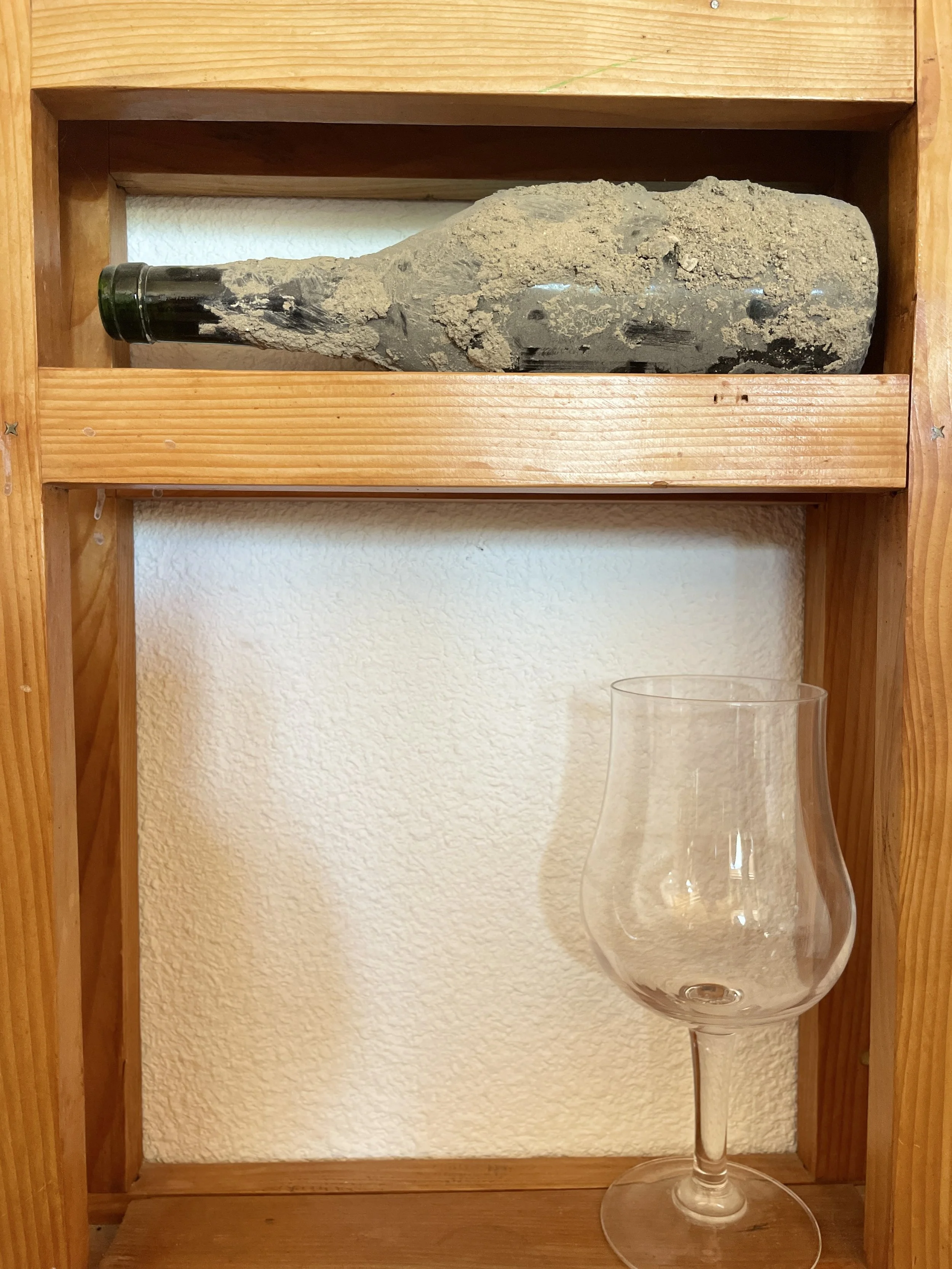
As we shifted from red to white, Andy pointed to a bottle tucked along the back of a shelf, its glass still caked with dried mud.
“This,” she said, lifting it carefully from its spot, “was one of the few bottles saved from the flood.”
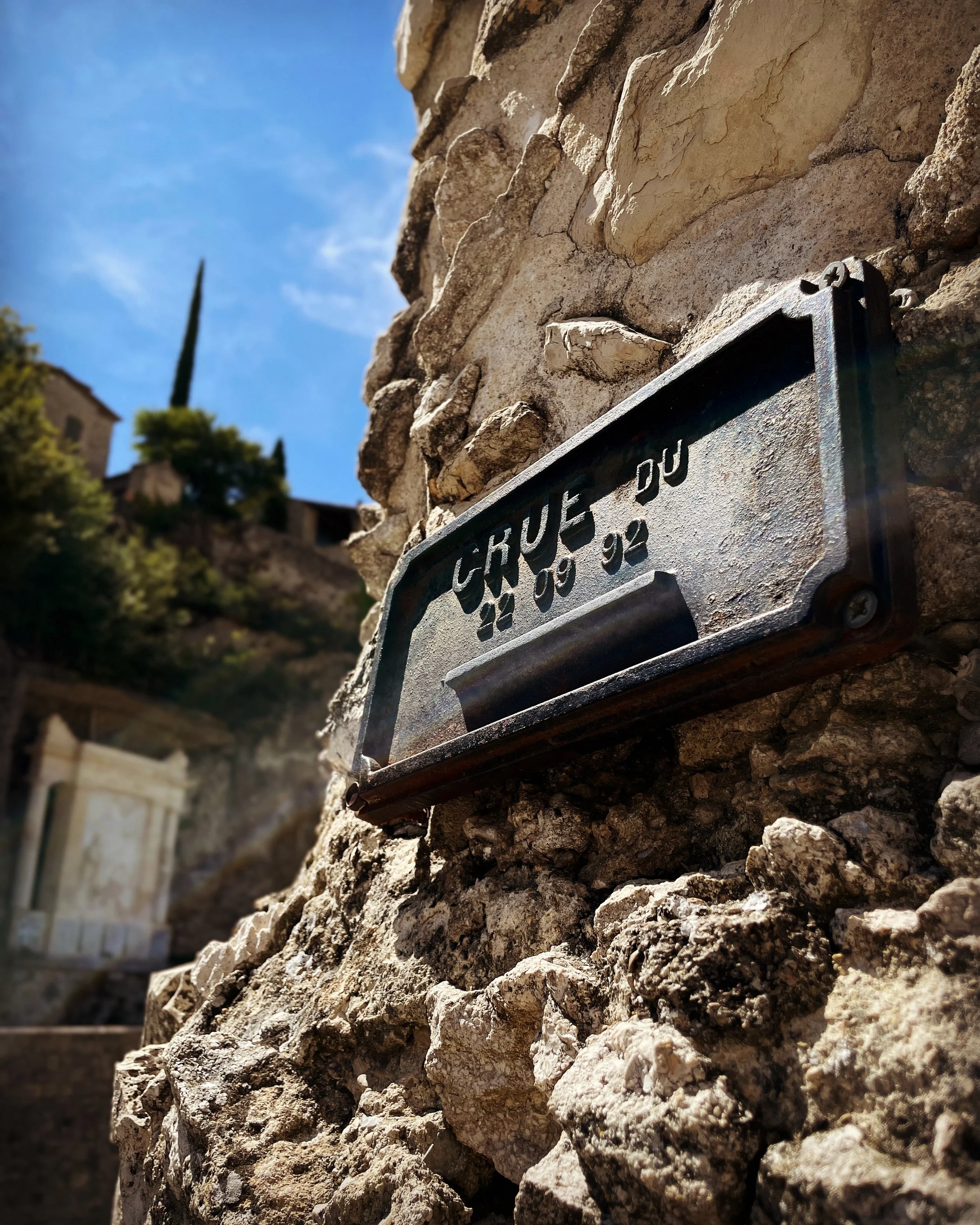
Andy and I exchanged a look. In this part of Provence, when someone mentions “the flood,” there’s no need for clarification, they mean the catastrophic flood of 1992 in Vaison-la-Romaine. Visitors still wander our streets hunting for the plaques that mark how terrifyingly high the water reached that day.
She placed the bottle on the counter, then reached for a worn magazine featuring her father in the aftermath.
“We had a storage facility in Vaison,” she said, tapping the number printed beneath his photograph. “We lost 33,000 bottles of wine in that flood… but this one was salvaged.”
We studied the image: a young boy in calf-high work boots standing atop a mountain of bottles submerged in thick mud, while a man, Françoise’s father, though decades younger, stood in the foreground holding one of the few bottles that survived, still perfectly intact. The caption read: Paul Joyet still wants to believe in his future as a winemaker in Vaison. This man from Lyon, who settled here eighteen years ago, has lost 33,000 bottles of his 1989 vintage from Domaine des Girassols.”
I couldn’t help but smile, thinking back to the now much older Paul that I had seen lazing on the porch in the cool Provençal morning. I was happy to know how things had turned out. That he not only had a future as a winemaker in the region, but was able to build a legacy that he could leave for not only for his daughter, but grandchildren to foster and care for long after.
As we finished the last glass of wine and our tasting was coming to a close, Françoise came around the bar and walked through the doors to the other space attached to the tasting room.
“All of the quilts used to line these walls,” she said, waving her hands over her head and around the room.
Now, the room was stacked with boxes of wine awaiting its new home.
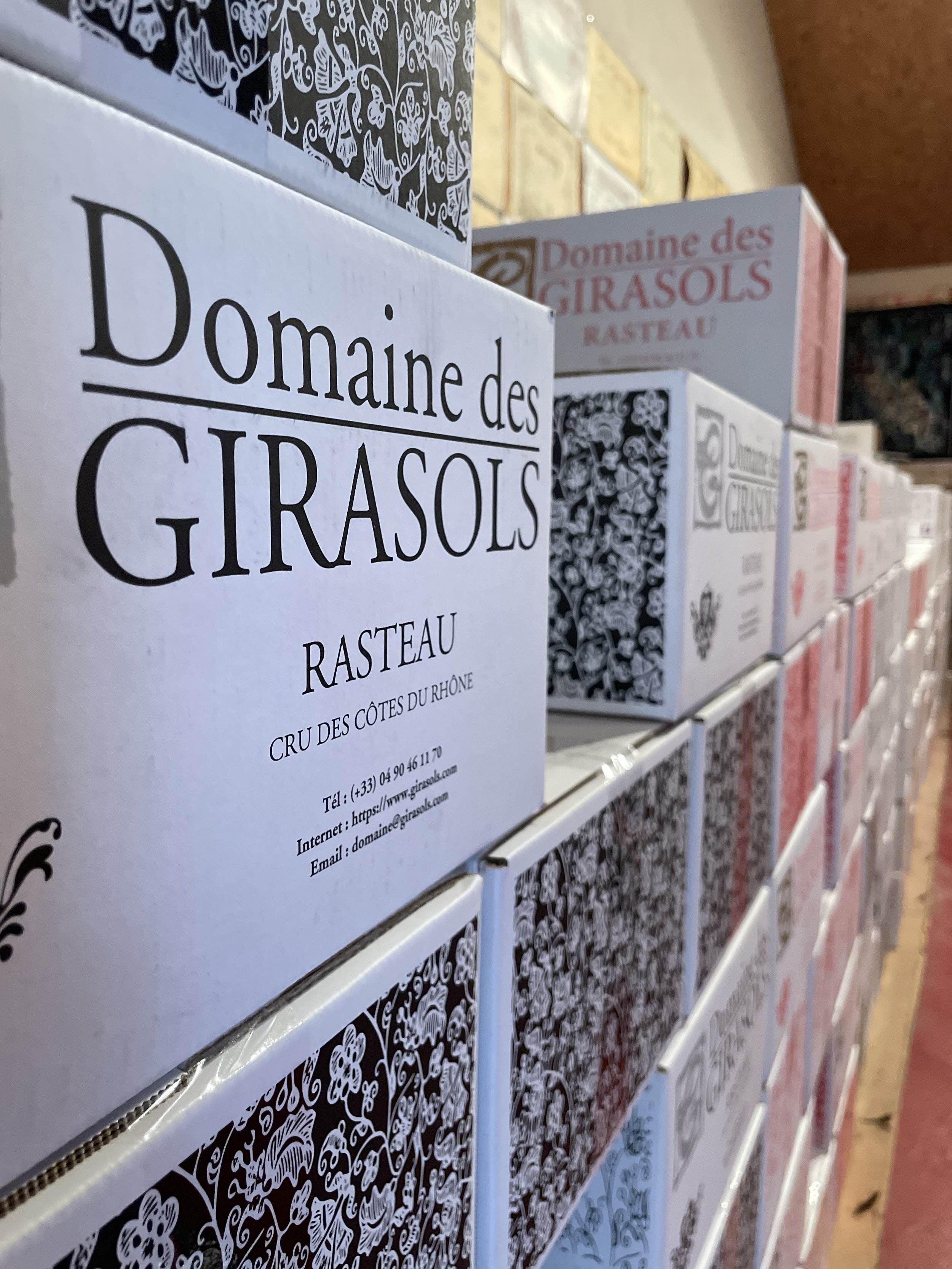
Around the back were the vats where the grapes began their slow transformation, the quiet heart of the domaine’s production. I stepped back and let myself take it all in, the rhythm of a family-run estate working in harmony with its land, and let out a small sigh. Domaine des Girasols was exactly what I had hoped to find in my search for a small, intimate, family-run production in Provence. You could feel it the moment you stepped out of the car: this wasn’t just a business. This was their life.
And standing there among the vines, the quilts, the stories, and the generations of care, I realized that places like this are why Provence stays with you long after you leave.
Visit Domaine des Girasols
Visiting Provence and hoping to enjoy a wine tasting?
Françoise, Jon, and Julien would be delighted to welcome you. Their tasting room is open:
Monday–Friday:
9am–12pm & 2pm–6pm
Saturday–Sunday:
10am–12pm & 3pm–6pm
Tastings are offered in both English and French, making the experience easy and enjoyable for all visitors.